Author Archive
 SARC-SEPAR Winter Field Day
 January 27th, 2025 |
  Author:
 Winter FD was pretty good!
Five of us set up in three sites at Derby reach including Paul VE7VP and 3 newer hams (Carl, Barbara, and Elaine from the last class). John VE7TI and Summer School graduate Grace VA7LZT came out and Grace was able to work 20m for a while which was great. We only made around 60 or 70 contacts, but we were operating more casually. We had a fair number of visitors, both Ham and non-Ham.
A full report will follow in the next Communicator.


SARC Bi-weekly Bulletin
January 22, 2025

Issued during the first and third week of each month, it provides a quick reference for member activities, resources and links for the following weeks.
ANNOUNCEMENTS
Creative Assistance Needed
Do you want to get to know the members of SARC/SEPAR better? Do you want to become a columnist with what is possibly the most widely read amateur radio newsletter in the world? Have we got a job for you! We are looking for a columnist to coordinate the bi-monthly “Member Profile” for the Radio-Active column of The Communicator. The task involves sending out a questionnaire to a prospective candidate and then creating a 500-1000 word story based on the answers, along with a couple of photos. You do not need to be an expert writer, and (if needed) the editors will help with syntax, spelling and grammar. If this appeals to you, please contact John VE7TI via [email protected].Parks-on-the-Air (POTA) Brochure Available
Those of us who do POTA are frequently approached by passers-by enquiring what we are doing. For this purpose, John VE7TI has created a SARC POTA brochure that can be given to those looking for additional information. The .pdf file is available for download at https://bit.ly/POTAbrochure.
10 GHz Beacon Featured in RAC Journal
You have heard about SARC’s 10 GHz activity on these pages previously, but now the beacon project has caught the attention of Dana Shtun VE3DS who writes the 10m and Down column for RAC's Canadian Amateur magazine. See page 10 of the January-February 2025 edition: https://www.rac.ca/digitaltca/. Update to the article: The beacon callsign is now VE7SAR/B and the power output 150 mW. More on 10 GHz below.
Thursday Get-on-the-Air (GOTA) Net On Hold
The GOTA net for new hams is on hold for now. We have several exciting initiatives underway to bring a new generation of ham radio operators into the hobby, including the Kwantlen Park ham radio summer school course, and a program to offer ham radio as a full-credit regular high school course. We expect to resume the net when we have a critical mass of newly certified graduates anxious to try out their radios and get comfortable making radio contacts.UPCOMING EVENTS
Meet the Royal Marines Event (Jan. 23)
The Royal Netherlands Army Signal Corp., callsign PA25MC, is organizing a
communications  event on Jan. 23rd from 1100 Z to 2000 Z.  PA25MC is organized and
supported by PI4VBD, the club\station of the Royal Army.  Here's their official statement:
"PA25MC is on the air for just 1 day to introduce Marines to the world of ham radio. We try
to use as many HF-bands as possible in SSB. Marines are used to speaking English but
naturally [they will] keep their communications short."  Look for PA25MC on the 10, 15
and 20m bands.
ARRL Winter Field Day (Jan. 25-26)
WFD is designed to help increase your level of preparedness and operating skills for disasters in winter environments, which present unique operating conditions. It has been suggested that SARC and SEPAR members deploy the SEPAR trailer for this event. Please respond to this email if interested.BC QSO Party (Feb. 1-2)
A team has been assembled to challenge the BCQP. We plan to operate two radios, CW on one and SSB on the other, both at 1 kw. The contest runs from 8 am to 8 pm Saturday and 8 am to 4 pm Sunday. If you have never contested before, you may choose to monitor or team up with an experienced operator who will help you get started. Let's see if we can beat last year's score of 1858 Qs and 1,842,308 points which got us the Top BC Multi-Op award. Check out contest details at: Orca DX and Contest Club -- BCQP Home Page.
Winlink Coaching (Saturday mornings with Horace by prior arrangement)
In follow-up to the Winlink workshop held in December, Horace VA7XHB will be available on Saturday mornings to assist members in setting up Winlink. If interested, contact Horace at [email protected] with your name, callsign, make and model of radio and interface.Related Item… SARC now has two Winlink Gateways
One is at Surrey Firehall One using callsign VE7HME-10 on 145.710 MHz and a second is on Concord tower at 100th Ave and King George Blvd using callsign VE7ADQ-10 on 145.770 MHz. Packet 1200 Baud and VARA FM Wide capable.Every Saturday Morning (except when other scheduled events conflict)
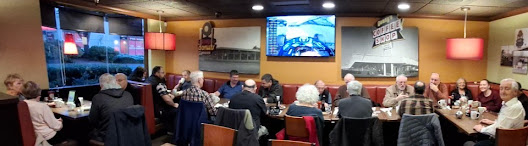
Members, spouses and prospective members are invited to join the SARC Breakfast social every Saturday morning from 7 to 9:30 am at Denny's Restaurant 6850 King George Blvd, followed by Operations & Training Centre ("OTC") activation from 9:30 am to noon at 5756 142 St. Surrey. At the OTC you may get help with your radio issues, operate the station radios including satellite station, participate in contests, write the exam, or join in workshops and training. Or just engage in friendly discussion with your fellow hams.SARC Official Calendar
Your official reference for dates and times of events is the SARC Google Calendar, which is updated as details change, so please check the homepage on the SARC website: www.ve7sar.net.NETS & REPEATERS
Tuesday Nets
Join the SEPAR net every Tuesday at 7:30 pm and the SARC net at 8 pm on either of the repeaters: North repeater is on 147.360 MHz tone 110.9 Hz and South repeater is on 147.360 MHz tone 103.5 Hz. IRLP and Echolink are only available on the North repeater.Sunday Monthly 220 MHz Net (next one is Jan. 26)
Join the 220 MHz net taking place at 7:30 pm on the last Sunday of every month on VE7RSC repeater 223.960 MHz -1.6MHz tone 110.9 Hz, with net control, Shawn VE7BD. This is not a "chat" net – just check in, exchange signal reports, and get on with your evening.Yaesu System Fusion (YSF) repeater 443.775 MHz+ tone 110.9Hz
This repeater is connected full-time to CQ-Canada (VE1AO) room 40678 – home to the Cross Canada C4FM Weekly Net on Wednesday 6 pm PST or 0200 UTC. Located on the Concord high-rise in Surrey, it is one of the few System Fusion repeaters in BC that is WIRES-X capable (i.e. it connects to the Internet). Using your Yaesu C4FM radio, you can use this repeater to talk to the world. It is connected to the highly fault-tolerant BC WARN Internet system, which is designed to remain operational during most internet outages. Familiarity with WIRES-X on our YSF repeater can play a crucial role in emergency preparedness.Net Reminders
"Net reminders" for those running or participating in various nets are automatically sent out by AdvancedAmateur.ca. If you are forgetful like me, you may want to receive reminders by signing up at Net Reminders.PROJECTS AND AD-HOC GROUPS
Satellite Station Project
Dino VE7NX is available to coach those who wish to learn how to make satellite contacts using SARC's new satellite station. Contact Dino [email protected] or reply to this email if you would like to learn more.Innovation Dept: 50 MHz and Up
As reported earlier, SARC's 10 GHz beacon VE7SAR/B running 150 mW is in continuous operation from our repeater site on Concord tower in Surrey. Dino VE7NX has promised to help members who would like to assemble suitable equipment to monitor the beacon.We can also report that last weekend, during the ARRL VHF 6m and above contest a successful 4-way 10 GHz CW contact was made between Scott VA7SC at Crescent Beach, Dino VE7NX at Boundary Bay, Mark VE7AFZ in Burnaby and Kirk VA7RKM on the Malahat Hwy north of Victoria. This was accomplished by bouncing signals off the North Shore mountains and tall buildings in Burnaby. The longest path was about 130 km.
Members Slava VE7LWW and Les VA7OM are working to construct their own 10 GHz equipment and hope to be operating soon.
What's next? Stay tuned for announcements about a 6m beacon and 24 GHz beacon, both of which are under construction and testing by Dino VE7NX and Scott VA7SC.

Contesting Group
To participate in scheduled contests, or if you wish to operate the club station radios on your own time, please reply to [email protected]. Coaching will be provided as needed. See WA7BNM Contest Calendar: Home for a complete list of available contests. Next big one is the British Columbia QSO Party on Feb. 1-2 (see Upcoming Events above for more information).IC-7300/IC-9700 Special Interest Group
This group is hosted by John Schouten VE7TI, with the most recent update on pp 37-41 of the January-February 2025 Communicator.Do You Want to Learn CW?
Check out the Long Island CW Club, which has a comprehensive and highly-regarded on-line program for learning CW and how to get comfortable using it: https://longislandcwclub.org/#.Vancouver Area Frequency List
Reg VA7ZEB has created a Vancouver Area Frequency List, which is a vetted list of useful frequencies across several services including Amateur, EmComm, Broadcast, Weather, LADD, Regional Road, FRS/GMRS, Railway, Airband and Marine. It can be easily downloaded in Generic CSV, Chirp and RT Systems format, or you can download it in PDF format for printing.Incoming QSL Bureau
Any member wishing to receive in-coming QSL cards should send Ken VE7BC an email at [email protected] or call/text him at 604-816-5775 and the cards will be collected for local distribution by Shawn VE7BD. Or, if you are simply wondering if Ken has any cards for you, please contact him.Download the January-February Communicator in LARGE or SMALL format, or read it on-line like a magazine.
Free VE7DXE Advanced Certification Course: [email protected]
Radio Amateurs of Canada (RAC) Advanced Certification Course
Please contact the course instructor Dave Goodwin, VE3KG, at [email protected] for information on how to register for RAC’s Advanced course.
Link to SARC’s Basic Ham Class Overview:
Welcome to our courses.pdf - Google Drive. The current course commenced Jan. 6, 2025 with 33 students registered.
ARRL Asks Hams to Send Radiograms via the Web
In a recent issue of the National Traffic System (NTS) Letter, the ARRL encouraged amateur radio operators to utilize the Radiogram portal on the web to submit free messages to friends and family. The link takes you to a webpage where you enter the particulars for sender and recipient, select a message and operators in the NTS will send it on to the recipient. Sending Radiograms helps volunteers hone their skills in preparation for emergencies. What happens next? A volunteer, FCC-licensed Amateur Radio operator will pick up your message from this web site and then send it, by Amateur Radio, over the air to other volunteers in the National Traffic System. The message will be received by a ham who lives in or near your recipient's city. Then, the message will be delivered in person or by telephone. For more information about The National Traffic System and traffic handling visit: https://nts2.arrl.org/training/. A typical sent message reads as follows:
From: JOHN SCHOUTEN
To: FRED SMITH
1234 ANY STREET
SURREY BC V0P 1R9
604 123 1234
[email protected]
WISHING YOU A VERY HAPPY BIRTHDAY. ALL THE BEST,
JOHN SCHOUTEN
WANTED OR FOR SALE BY MEMBERS

Monty VA7MMW is still looking for a female connector like the one shown for his Yaesu FT-101B. It is a CINCH JONES S-312-CCT POWER SOCKET 12PIN. If you can help Monty please contact him at [email protected].
73,
SARC on 24 GHz!
Believed the first in BC
On Jan 22, 2025 at 14:30 pm local time, two members of the Surrey Amateur Radio Communications Society completed what is believed to be the first 24 GHz terrestrial contact in BC.
Scott VA7SC was in grid CN89nb at Crescent Beach and Dino VE7NX was in CN89ic at Boundary Bay, approximately 10 km distant. Scott was transmitting just 1 mW using a mixer and local oscillator into a 24" dish with shepherd's crook. Dino was using a Wavelab module delivering 80 mW output with controller and 12" dish. SSB signals were loud and clear. Antenna orientation was critical, and with a few degrees off-target the signal was gone.
We fully acknowledge and thank Hugh VA3TO and Peter VA3ELE for their assistance in making this a reality.
There's a video at https://youtube.com/shorts/PzVmCyqCIJY
SARC Bi-weekly Bulletin
January 21, 2025
Issued during the first and third week of each month, it provides a quick reference for member activities, resources and links for the following weeks.
ANNOUNCEMENTS
Thursday Get-on-the-Air (GOTA) Net Temporarily Discontinued
The GOTA net is for new hams. After a short hiatus, it is expected to resume upon completion of the current basic ham class in March 2025 when newly certified graduates will be anxious to try out their radios and get comfortable making radio contacts.
Writing Help Needed
Do you want to get to know the members of SARC/SEPAR better? Do you want to become a columnist with what is possibly the most widely read amateur radio newsletter in the world? Have we got a job for you! We are looking for a columnist to coordinate the bi-monthly “Member Profile” for the Radio-Active column of The Communicator. The task involves sending out a questionnaire to a prospective candidate and then creating a 500-1000 word story based on the answers, along with a couple of photos. You do not need to be a top-notch writer, and the editors will help with spelling and grammar. If this appeals to you, please contact John VE7TI via [email protected].
Parks-on-the-Air (POTA) Brochure Available
Those of us who do POTA are frequently approached by passers-by enquiring what we are doing. With this in mind, John VE7TI has created a SARC POTA brochure that can be given to those interested in additional information. The .PDF file is available for download at https://bit.ly/POTAbrochure.
10 GHz Beacon Featured in RAC Journal
You have heard about the 10 GHz activity on these pages previously, but the beacon project has caught the attention of Dana Shtun VE3DS who writes the 10m and Down column for RAC's Canadian Amateur magazine. See p. 10 of the January-February 2025 edition: https://www.rac.ca/digitaltca/. Update to the article: The beacon callsign is now VE7SAR/B and the power output 150 mW.
UPCOMING EVENTS
Meet the Royal Marines Event (Jan. 23)
The Royal Netherlands Army Signal Corp., callsign PA25MC, is organizing a communications event on Jan. 23rd from 1100 Z to 2000 Z. PA25MC is organized and supported by PI4VBD, the club station of the Royal Army. Here's their official statement: "PA25MC is on the air for just 1 day to introduce Marines to the world of ham radio. We try to use as many HF-bands as possible in SSB. Marines are used to speaking English but naturally [they will] keep their communications short." Look for PA25MC on the 10, 15 and 20m bands.
ARRL Winter Field Day (Jan. 25-26)
WFD is designed to help increase your level of preparedness and operating skills for disasters in winter environments, as the potential for freezing temperatures, snow, ice, and other hazards present unique operating conditions. It has been suggested that SARC and SEPAR members deploy the SEPAR trailer for this event. Please respond to this email if interested.
BC QSO Party (Feb. 1-2)
A team is being assembled to challenge the BCQP. We plan to operate two radios, CW on one and SSB on the other, both at 1 kw. The contest runs from 8 am to 8 pm Saturday and 8 am to 4 pm Sunday. If you have never contested before, you may choose to monitor or team up with an experienced operator who will help you get started. Let's see if we can beat last year's score of 1858 Qs and 1,842,308 points which got us the Top BC Multi-Op award. Check out contest details at: Orca DX and Contest Club -- BCQP Home Page.
Winlink Coaching (Saturday mornings with Horace by prior arrangement)
In follow-up to the Winlink workshop held on Dec. 14, Horace VA7XHB will be available on Saturday mornings to assist members in setting up Winlink. If interested, contact Horace at [email protected] with your name, callsign, make and model of radio and interface.
Related Item… SARC now has two Winlink Gateways
One is at Surrey Firehall 1 using callsign VE7HME-10 on 145.710 MHz and a second is on Concord tower at 100th Ave and King George Blvd using callsign VE7ADQ-10 on 145.770 MHz. Packet 1200 Baud and VARA FM Wide capable.
Every Saturday Morning (except when other scheduled events conflict) Members, spouses and prospective members are invited to join the SARC Breakfast social every Saturday morning from 7 to 9:30 am at Denny's Restaurant 6850 King George Blvd, followed by Operations & Training Centre ("OTC") activation from 9:30 am to noon at 5756 142 St. Surrey. At the OTC you may get help with your radio issues, operate the station radios including satellite station, participate in contests, write the exam, or join in workshops and training. Or just engage in friendly discussion with your fellow hams.
SARC Official Calendar
Your official reference for dates and times of events is the SARC Google Calendar, which is updated as details change, so please check the homepage on the SARC website: www.ve7sar.net.
NETS & REPEATERS
Tuesday Nets
Join the SEPAR net every Tuesday at 7:30 pm and the SARC net at 8 pm on either of the repeaters: North repeater is on 147.360 MHz tone 110.9 Hz and South repeater is on 147.360 MHz tone 103.5 Hz. IRLP and Echolink are only available on the North repeater.
Sunday Monthly 220 MHz Net (next one is Jan. 26)
Join the 220 MHz net taking place at 7:30 pm on the last Sunday of every month on VE7RSC repeater 223.960 MHz -1.6MHz tone 110.9 Hz, with net control, Shawn VE7BD. This is not a "chat" net – just check in, exchange signal reports, and get on with your evening.
Yaesu System Fusion (YSF) repeater 443.775 MHz+ tone 110.9Hz
This repeater is connected full-time to CQ-Canada (VE1AO) room 40678 – home to the Cross Canada C4FM Weekly Net on Wednesday 6 pm PST or 0200 UTC. Located on the Concord high-rise in Surrey, it is one of the few System Fusion repeaters in BC that is WIRES-X capable (i.e. it connects to the Internet). Using your Yaesu C4FM radio, you can use this repeater to talk to the world. It is connected to the highly fault-tolerant BC WARN Internet system, which is designed to remain operational during most internet outages. Familiarity with WIRES-X on our YSF repeater can play a crucial role in emergency preparedness.
Net Reminders
"Net reminders" for those running or participating in various nets are automatically sent out by AdvancedAmateur.ca. If you are forgetful like me, you may want to receive reminders by signing up at Net Reminders.
PROJECTS AND AD-HOC GROUPS
Satellite Station Project
Dino VE7NX is available to coach those who wish to learn how to make satellite contacts using SARC's new satellite station. Contact Dino [email protected] or reply to this email if you would like to learn more.
Innovation on 50 MHz and Up
As reported earlier, SARC's 10 GHz beacon VE7SAR/B running 150 mW is in continuous operation from our repeater site on Concord tower in Surrey. In follow-up to this achievement, Dino VE7NX operating from Concord tower, Scott VA7SC in Langley and Kirk VA7RKM in Victoria recently made 3-way contact on 10 GHz by bouncing signals off Mt. Baker. Dino has promised to help members who would like to assemble suitable equipment to monitor the beacon.
What's next, you ask? Stay tuned for announcements about a 6m beacon and 24 GHz beacon, both of which are under construction and testing by Dino VE7NX and Scott VA7SC.
Contesting Group
To participate in scheduled contests, or if you wish to operate the club station radios on your own time, please reply to [email protected]. Coaching will be provided as needed. See WA7BNM Contest Calendar: Home for a complete list of available contests. Next big one is the British Columbia QSO Party on Feb. 1-2 (see Upcoming Events above for more information).
IC-7300/IC-9700 Special Interest Group
This group is hosted by John Schouten VE7TI, with the most recent update on pp 37-41 of the January-February 2025 Communicator.
POTPOURRI
Do You Want to Learn CW?
Check out the Long Island CW Club, which has a comprehensive and highly-regarded on-line program for learning CW and how to get comfortable using it: https://longislandcwclub.org/#.
Vancouver Area Frequency List
Reg VA7ZEB has created a Vancouver Area Frequency List, which is a vetted list of useful frequencies across several services including Amateur, EmComm, Broadcast, Weather, LADD, Regional Road, FRS/GMRS, Railway, Airband and Marine. It can be easily downloaded in Generic CSV, Chirp and RT Systems format, or you can download it in PDF format for printing.
Incoming QSL Bureau
Any member wishing to receive in-coming QSL cards should send Ken VE7BC an email at [email protected] or call/text him at 604-816-5775 and the cards will be collected for distribution by Shawn VE7BD. Or, if you are simply wondering if Ken has any cards for you, please contact him.
Download the January-February Communicator in LARGE or SMALL format, or read it on-line like a magazine.
Free VE7DXE Advanced Certification Course: [email protected]
Radio Amateurs of Canada (RAC) Advanced Certification Course
Please contact the course instructor Dave Goodwin, VE3KG, at [email protected] for information on how to register for RAC’s Advanced course.
Link to Basic Ham Class Overview: Welcome to our courses.pdf - Google Drive. The current course commenced Jan. 6, 2025.
ARRL Asks Hams to Send Radiograms via the Web
In a recent issue of the National Traffic System (NTS) Letter, the ARRL encouraged amateur radio operators to utilize the Radiogram portal on the web to submit free messages to friends and family. The link takes you to a webpage where you enter the particulars for sender and recipient, select a message and operators in the NTS will send it on to the recipient. Sending Radiograms helps volunteers hone their skills in preparation for emergencies. What happens next? A volunteer, FCC-licensed Amateur Radio operator will pick up your message from this web site and then send it, by Amateur Radio, over the air to other volunteers in the National Traffic System. The message will be received by a ham who lives in or near your recipient's city. Then, the message will be delivered in person or by telephone. For more information about The National Traffic System and traffic handling visit: https://nts2.arrl.org/training/. A typical sent message reads as follows:
From: JOHN SCHOUTEN
To: FRED SMITH
1234 ANY STREET
SURREY BC V0P 1R9 604 [email protected]
WISHING YOU A VERY HAPPY BIRTHDAY. ALL THE BEST,
JOHN SCHOUTEN
WANTED OR FOR SALE BY MEMBERS

Monty VA7MMW is still looking for a female connector like the one shown for his Yaesu FT-101B. It is a CINCH JONES S-312CCT POWER SOCKET 12PIN. If you can help Monty please contact him at [email protected].
~73, John VA7XB [email protected]
Five-band HF Linked Dipole [updated January 2025]
An improved build
This antenna was first described in the November-December 2023 Communicator. After a year of using it, I’ve developed some improvements. - Updated January 2025
I appreciate inexpensive but effective antenna design. Sure, you can spend hundreds of dollars to buy a multiband antenna for POTA or GOTA but they are so simple to build, why would you want to? You can enhance your skills and communication capabilities by constructing custom antennas.
One popular and versatile option is the multi-band HF dipole antenna often called a segmented or linked dipole. This antenna design allows for effective communication across multiple HF bands by connecting or disconnecting sections along its length making it an inexpensive asset for ham radio operators, particularly outdoors enthusiasts and those needing a light, packable wire antenna that can be erected almost anywhere, and with good results—better than an end-fed, because each segment of the antenna is pre-tuned during construction, and can be used safely even when no antenna tuner is available.
Ideally it is hung from a pole or tree branch at 20 feet (6m) as an Inverted V, with the center point high and the dipole legs spread at least 110-120 degrees. I have worked the globe with this set-up on sideband and 20 Watts.
 |
| Oly one side of the dipole is shown |

~ John VE7TI
Manna80 and other Special Event Stations
You may wish to add these to your calendar
We will publish a report in The Communicator's next issue.
I would like to inform you about a few special event stations we will put up in the next few months.
February 14,15 and
16th, PA80OV will be operational from Gennep, Netherlands.
I will be a guest operator, and probably the organisation has written to you
allready, but it is nice to know.
https://radioclublimburg.nl/pa80ov/
----------------------------
The two others are also very interesting.
At the end of WW2, the Netherlands suffered a
hunger winter. Allied forces conducted a humanitarian action called Operation
Manna.
In April this year, 80 years ago, tons of food was dropped over the western
part of the Netherlands, saving many people from starvation and death.

To commemorate this event, we will activate a
couple of stations, including GB80MAN, VE80MAN, VK80MAN, PH80MAN.
We are hoping Poland is participating as well, and we hope the USA will put up
a station.
https://manna80.radio/the-team-in-the-netherlands/
As you have seen some SES from us, we will put
up PH80MAN at a former drop zone.
I have added a flyer with this mail. This one is in Dutch, but an English
version is under construction... will follow as soon as it is done!
Lastly, I would like to
inform you about PA82AD.
This is a call we used 5 years ago to celebrate 75 years of freedom. We held a
DX-pedition but due to COVID, we could not really complete our goals.
Please read the qrz.com page from bottom up.
To finish this DX-pedition as planned, we will
be operational for a very last time.
Thanks again for reading, and hope to hear you on the bands.
73,
~ Sander PD9HIX
A different kind of Foxhunt
Suitable for the urban fox
From the January-February 2025 SARC Communicator
The last few months, I've been thinking about a different way to do a Foxhunt. My vision was to have a Foxhunt available whenever you want, especially this time of year. Not everyone lives in town, and everyone's busy shopping and might not be able to dedicate an afternoon on a specific day for a group search. But what if the fox kept calling you out for a few minutes here and there, whenever you had a chance? No pressure, just try it out and see what you can find with your gear, experimenting with different antennas to get the best results. Go get that Fox!
Where to start with my build? You guessed it: Google and YouTube. The first step was to make a Fox using things I had in my toolbox. I got a Baofeng radio, Arduino UNO, batteries, a waterproof box, and a Drok buck converter. Simple enough, right?
I first searched using Miss Google and came across this: https://www.hackster.io/nfarrier/auto-keyer-for-radio-fox-hunting-e89b99 "Cool, I can do this," I thought, so I did. After putting it all together, I programmed the Arduino UNO using the Arduino software with the code from that website. I set up the CW message, and everything tested just fine. My vision was starting to come true!
 |
| My power supply was an 18 volt 5.0 Ah Lithium-Ion Battery (Makita BL1850b) feeding in the Drok Buck Converter to reduce the voltage to 7.4 Volt for the Radio and that voltage was also perfect to feed the Arduino Uno as it has a 12 volt connection with its own regulator to supply 5 volt to the board. |
I could hear it from the east and west side of town. All was good darn... a few days later I couldn't hear it anymore until I was right beside it. I took the Fox home and discovered the TX (transmit) wasn't putting out power anymore, even though the battery was still good. My Fox SX5 Mosfet transistor must have failed. It must have been spending too much time in TX mode. So, I replaced the radio and changed the transmit message, reducing the time by almost 50 percent.

There goes the fox hunt, second radio blown. How disappointed you all would be! I talked to a fellow ham about Baofeng radios. He uses them more often than me, and he showed me in the manual that the duty cycle is very small, 03/03/54 minutes (RX/TX/Standby). My fellow ham had a spare radio he wasn't using, so I bought it from him.
I did a few more programming changes to adjust the duty cycle. I also decided to add "MORE POWER!" (à la Tim Allen) So, I added a second Makita battery for a longer stay in the den.
I relocated the fox to be closer to home, just because I know I'll need to replace the batteries in a few days. For those of you in the area, I hope you all get a chance to find the Fox.
Happy Fox Hunting! 73,
~The Silver Fox VE3BQM













