Author Archive
 Cycle 24 ….Not Really
 July 21st, 2014 |
  Author:
  |
| Courtesy: STCE Newsletter |
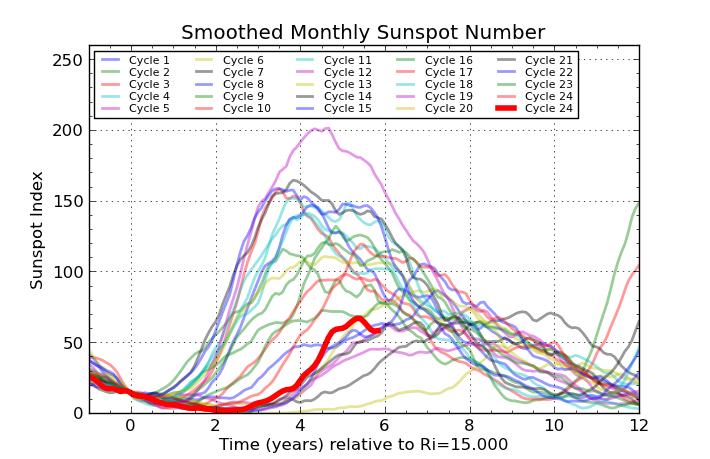
My recent postings of Cycle 24's performance has made me wonder about previous cycles. I'm still hunting for the source, but I recall reading of Cycle 19's F2 MUF actually peaking out at over 70MHz on several days of that monster cycle! Knowing just how rare (and difficult) it is to get the F2 MUF to even approach 50MHz, reaching 70MHz is just further testimony to Cycle 19's unheralded performance. I can only imagine how exciting 6m must have sounded at those times, with intercontinental signals of bone-crushing strength.
Although Cycle 19 may be the largest in recorded history, our documentation of solar activity only began in 1759, or Cycle 1. We know that our sun is roughly 7.5 billion years old and in relative terms, evolved rather quickly into something close to what we see today as a main-sequence star. Assuming an 11 year cycle, that's roughly 409 million solar cycles or half that number if you consider the 22-year pole-reversal cycle. Either way you look at it, that's a lot of cycles! I'd be willing to wager that several thousands of these cycles, if not hundreds of thousands, would have made Cycle 19 look pretty wimpy by comparison.
Such cycles make me wonder...just how high could the F2 MUF reach during those cycles?....would it reach 2m or even beyond? It's hard to imagine world-wide F2 propagation on 2m or higher, but why not?
With the Sun almost half-way through its life, there is no question that there are many more gigantic cycles yet to play out. With the existence of radio and human life being just a momentary flash in time, I wonder if any of them will ever be enjoyed by radio amateurs?
SMD Kits

I've been intrigued for some months now by the proliferation of SMD parts kits widely available from Asian manufacturers being sold on E-Bay. Resistor, capacitor and inductor kits, containing significant numbers of standard-value parts and in various sizes are being offered at attractive prices. With many sellers throwing in free-shipping, I find myself being tempted more and more to press the "Buy Now" key and fear that I will not be able to hold out much longer.
I have had limited experience with SMD parts, when building a small 40m QRP transceiver several years ago called the SMK-1. As I recall, it had 72 SMD parts....the bigger ones, 1206 size. I recall finding the assembly and soldering of these SMD parts to be somewhat tedious and less than enjoyable. I usually only soldered a half dozen parts at one sitting. After a few weeks of periodic assembly, I was delighted to see the circuit come to life once power was applied as I was definitely not looking forward to trouble shooting the board! Perhaps my technique of fluxing and the method of holding the component in place with a homebrew 'third-hand' device was not ideal or maybe my soldering iron was not properly sized for the job but I do have a desire to try it again.
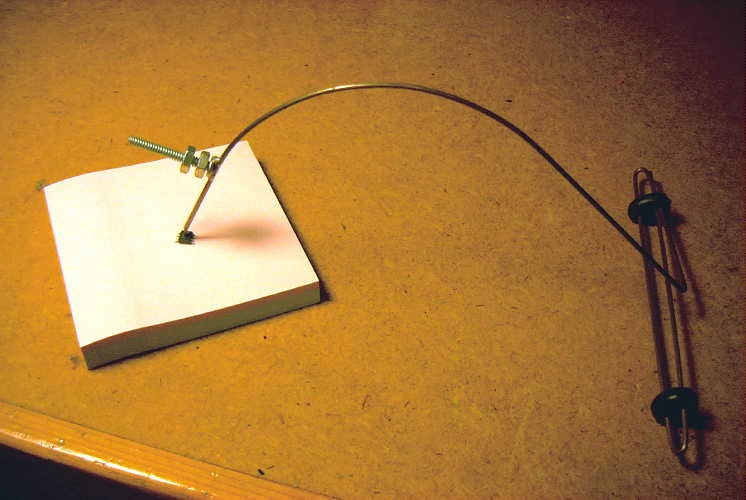
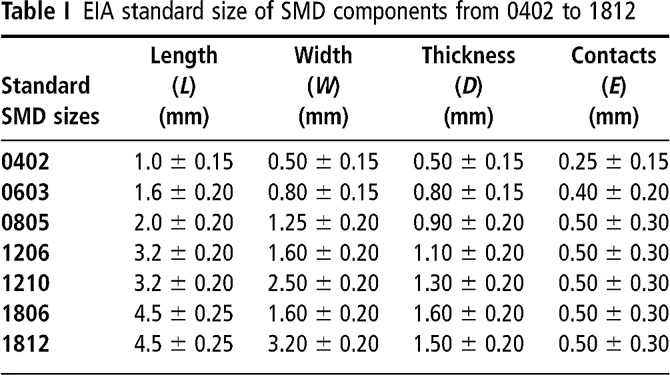
A 630m transverter, now planned out, would really lend itself nicely to SMD construction but realistically, the only size I would consider is 1206 at the smallest.
 |
| Courtesy: www.emeraldinsight.com |
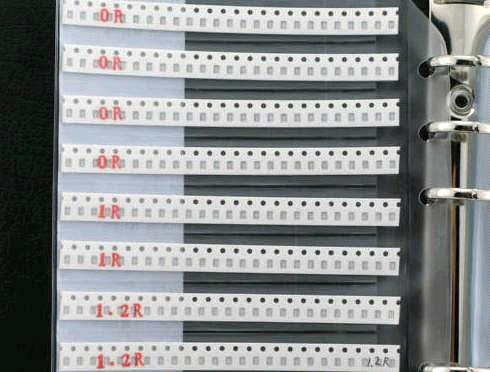 Why I am really contemplating the purchase of more SMD parts is somewhat vexing to me....perhaps it is simply my 'concrete-sequential' thinking style making me lust after all of these tiny parts, with all of them so neatly organized in their holders, begging to be brought to life by my own hands. Or maybe I just want to prove that my 66-year-old eyes and hands are still capable of working with these things.
Someone talk me out of this before it's too late.
Tuning ‘Ten’
 |
| Courtesy: VK6YSF |
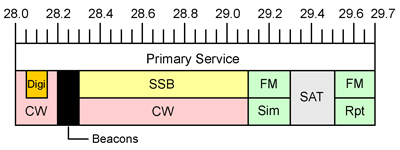
I've always considered 10m to be the 'other magicband'. When it's good in the fall / winter DX season, it is incredible, but during the summer months can often sound so very different. When I first became interested in shortwave radio as a pre-teen, back in the late stages of monster Cycle 19, I recall listening to 10m signals from before dawn to after midnight on most winter days. Considering the poor receiver I was using, a Hallicrafters R-510A, it was amazing that I could hear anything at all with it on 28MHz. Having no RF stage, it was likely as deaf as a post...
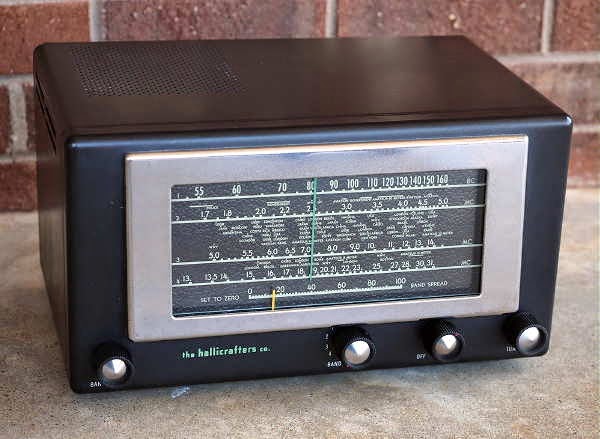
....yet, S9 + AM signals bombarded the band, from one end to the other (all 1/4" of it) late into the night, demonstrating just how good the propagation really was. Heterodynes battled for domination everywhere as if the nearly 2MHz wide band was not fat enough to accommodate all of the frenzied action.
Even today, in the heat of a mid-summer morning, 'ten' continues to amaze me, but in different ways. Tuning across the band earlier this week yielded a bounty of beacons, all diligently doing as instructed and proclaiming 'ten' still open for business.
OA4BB
W6XV (CA)
VE4TEN
LU8XW
PY2WFG
PT2SSB
N4PAL (FL)
K6FRC/B4 (CA)
K5GJR (TX)
KC5MO (TX)
AL7FS (AK)
WA6APQ (CA)
K8NDB (AZ)
K6FRC/B2 (CA)
PT9BCN
W3HH (FL)
PY4MAB
AC4DJ (FL)
XE2WK
K5AB (TX)
WA4ROX (FL)
K5TLL (MS)
K6FRC/B (CA)
I've always wondered if these mid-summer signals are all sporadic-E, multi-hop Es or a mixture of Es and F2. My propagation-gut feeling supports the latter mode since so many of the South American signals are strong and with little QSB. I think in all likelihood, the SA beacons are arriving via an F2 link into an Es link back to VE7, but the absence of any first-hop Es signal between here and Florida makes me wonder if that is really the case. If this is all F2, save for the Californian, Alaskan and Manitoban signals, it is really astounding considering the time of year.
No matter what the season, tuning 10m is always a delight and a reminder of my initial fascination with the magic of radio and just how truly amazing the band can be when at its best. Hopefully, it looks as though we may enjoy at least one more good winter out of this cycle on my 'other magicband'.
Capricious Cycle 24
 |
| July 6th - Courtesy: nasa.gov |
 |
| Sun Today - Courtesy: nasa.gov |
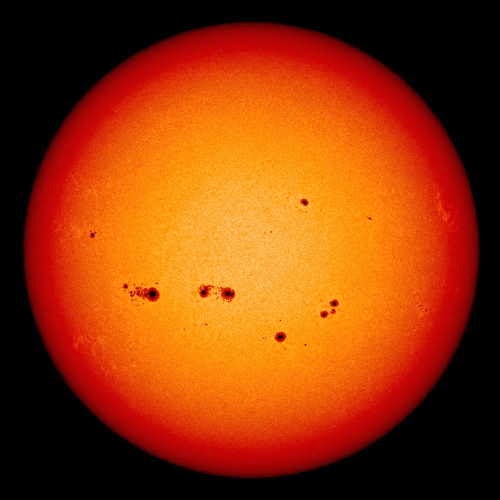
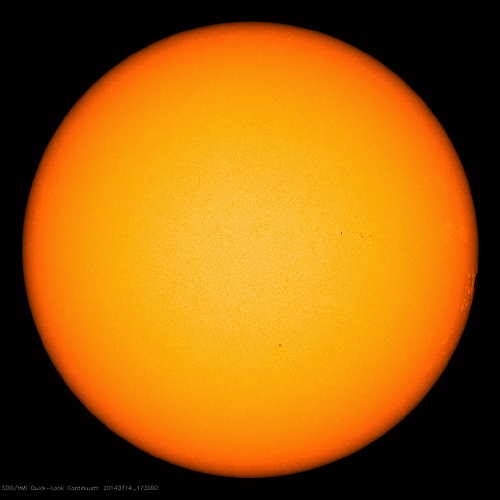
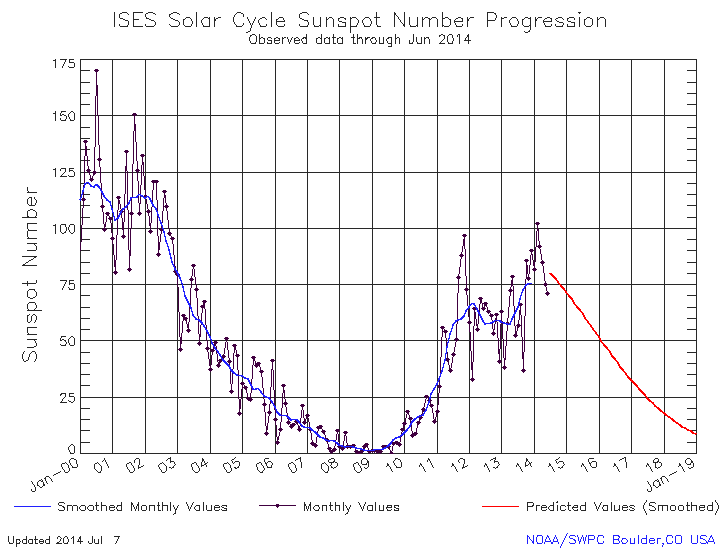
What a difference a week can make, even on something the size of the sun! Boasting an SFI of just over 200 on July 6th, today's numbers have fallen to 109 along with the disappearance of most sunspot activity.
It's really too bad that this last surge of activity did not occur in November or December when we would have seen a marked increase in HF F2 conditions, along with a tiny hope of some 6m intercontinental propagation. Normally, here on the west coast, we have at least one or two 6m openings to Europe each summer, lasting from a few minutes to several hours. So far this summer, this transpolar path has been missing and I suspect largely because of the high level of solar activity. The long haul transoceanic openings that we have had (to Japan and to Africa) did not have to traverse the signal-absorbing polar auroral zone as would normally be the case. Whether these transpolar openings in the summer are true Es or something different is a topic for deeper discussion!
 |
| Courtesy: http://www.swpc.noaa.gov/SolarCycle/ |
I'm hoping, and somehow suspect, that this isn't the last hurrah for what has generally been a most unusual solar cycle.
VE7 630m CW Beacons Report
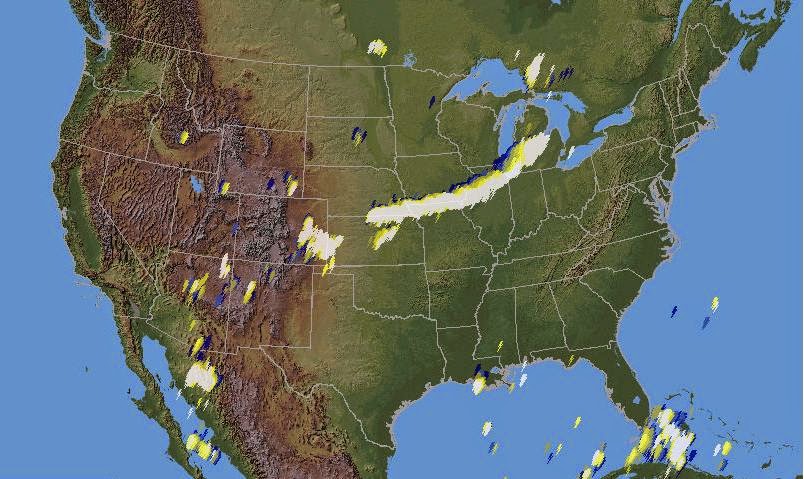
 Saturday night's CW beaconing by myself and VE7BDQ on 630m CW produced a number of interesting heard reports from various directions. It seems as though most receiving stations were bothered by the high level of thunderstorm QRN, very common at this time of the year and usually the limiting factor in reception. The Vaisala lightning map indicated various pockets of lighting in the PNW and a solid wall further to the east. Being located near any of these cells would make it difficult to hear anything at all and all but impossible nearer the wall.
 |
| Courtesy: vaisala.com |
Nevertheless, reception reports, often of both beacons, were received from Washington, Oregon, Utah, British Columbia, Alberta and as far east as Saskatoon, SK. It seemed like stronger signals were reported from the east rather than from the south or south-east which is more often the case. I suspect that the lower level of lightning in this direction, rather than enhanced E-W propagation, was the main reason for the nice 'over the Rockies' reception.
Thanks to the following enthusiasts who were kind enough to listen and to report on Saturday night's activities, hopefully I haven't missed anyone:
KK7UV (Steve) MT *
W7SWL (Bob) AZ *
VE6TA (Grant) Alberta
AA7U (Steve) OR
VA5LF (Sean) Saskatchewan
VA7JX (Jack) British Columbia
WY3B (Mike) HI *
W7WKR (Dick) WA
K7WV (Tom) WA
KU7Z (Mark) UT
W7OIL (Dan) WA
G0NSL (Brian) UK *
Colin Newell, British Columbia
* stations reporting no reception
It appears that even under fairly severe conditions (mid-summer QRN), small backyard antenna systems and 100W can propagate well enough for CW contacts on the 630m band. The band is certainly much more prop-friendly than 2200m and quiet winter conditions will be even better. In the meantime I hope to make some crossband contacts with anyone that might like to try that mode.
“Night of Nights” + VE7 CW Beacons – tonight
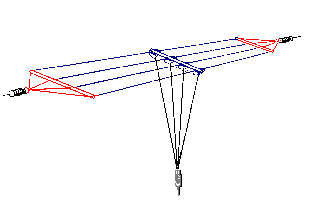
As many of you are aware, tonight from 0001Z-0700Z (1701- midnight PDT) is the annual 'Night of Nights' reactivation of many maritime CW MF stations operating near the 630m band. With Canadian amateurs recently getting 472-479KHz operating privileges, VE7BDQ and myself will both be operating CW beacons during the event.
VE7BDQ will transmit on 474.00 KHz while VE7SL will be on 473.00KHz. Both stations will be at the 100W power level.
Reception reports of either station would be gratefully received and confirmed by QSL if requested. Hopefully the usual noisy summer conditions will not detere listener activity.
I have more information on the 'Night of Nights' activity posted in an earlier blog if you are not aware of the event.
500KHz Lives Again – 2014 Night of Nights
 |
| Courtesy: Maritime Radio Historical Society |
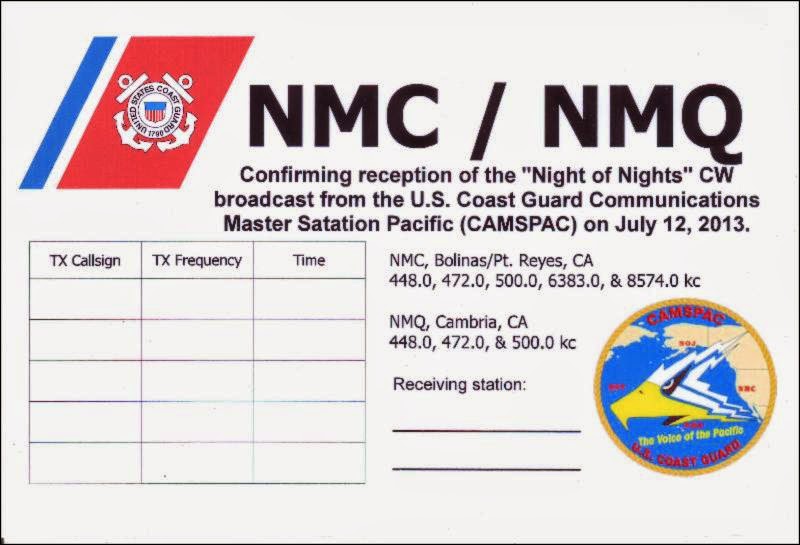
This year's annual Maritime Radio Historical Society's event, to mark the anniversary of the end of maritime CW in 1999, will take place Sunday, July 13, from 0001Z until 0700Z (Saturday, July 12, from 1701 until midnight PDT). This year's event may be historic in itself in that it will likely be the final year for any of the U.S. Coast Guard stations to ever be heard again on CW, as the equipment and wiring for this mode is now being dismantled.
 |
| Courtesy: Maritime Radio Historical Society |
Commercial CW land station transmitters from WLO (Mobile, AL), KLB (Seattle, WA), KFS (San Francisco, CA), KPH (Bolinas, CA) and KSM (Pt. Reyes, CA) should be active near 500KHz as well as on HF.
(late update: due to operator illness, KLB will not be participating)
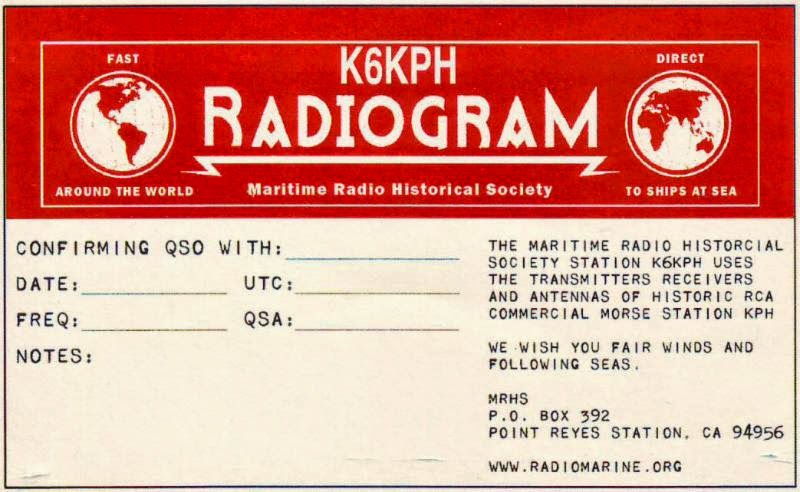
USCG stations NMC (Bolinas/Pt. Reyes), NMQ (Cambria /Pt. Reyes) and NMW (Astoria / Pt. Reyes) will also be transmitting below 500KHz as well as on HF. QSL's confirming reception of CG stations as well as for K6KPH and KSM will be available following the event.
K6KPH, the MRHS's amateur radio station located at the Pt. Reyes, CA site, will also be active on the HF bands during the event.
For a nice historical 'look back', the MRHS has some great stories associated with HF and MF maritime operations. Further details of the event detailing times and exact frequencies are available from MRHS newsletter #45.
Lastly, if you never had the opportunity to listen to '500' back in its heyday then you will surely enjoy this recording made by K2NP in March,1966 and presented with thanks to N1EA. Listening to this 500KHz action reminds me of 20m CW during the annual DX contest! What land stations can you identify in the pileups? Hopefully, when all North American amateurs gain access to the band, it will sound like this once again.













