Author Archive
 More ‘Hydroponic’ RF
 August 1st, 2015 |
  Author:
  |
| courtesy: arrl.org |
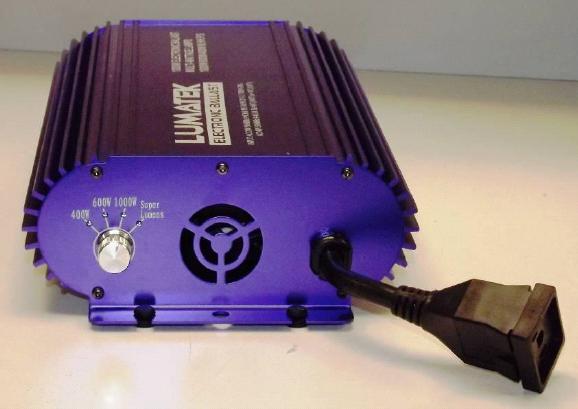
Some of the test products were ordered and purchased through Amazon and through Sears ... the ARRL's thorough report makes it obvious that rules are being ignored and amateurs are paying the price.
“The level of conducted emissions from [these devices] is so high that, as a practical matter, one RF ballast operated in a residential environment would create preclusive interference to Amateur radio HF communications throughout entire neighborhoods,” ARRL General Counsel Chris Imlay, W3KD, wrote in each complaint. The devices exceeded conducted emission limits under all test conditions, “sometimes by extreme margins, throughout most of the HF range ...”
In a similar vein as its recent complaint about marketing of certain RF lighting devices by The Home Depot, the ARRL pointed out that there were no FCC labels on two of the devices mentioned nor any FCC compliance information “anywhere in the documentation, or in or on the box, or on the device itself,” in violation of FCC Part 18 rules.
The League asked the FCC to require removal of all such illegal “grow light” devices from retail sale and marketing and the recall of those devices already sold or available for retail sale, and it said the device importers should be subject to a forfeiture proceeding.
With the proliferation of both legal and illegal 'hydroponic' operations, this kind of QRN is probably just the tip of the iceberg. It's good to see the ARRL slowly pounding away at the rule-breakers on behalf of American amateurs.
I see these same devices being sold on E-Bay, where presumably, they could be purchased worldwide and installed anywhere. As well, several of the U.S. online dealers state "We ship to Canada" ... just great.
Hopefully Industry Canada and RAC are gearing-up for the fight.
The VE3KCL Balloons

From the website of Hans Summers (GØUPL) comes news of a 3rd balloon launch from Canada.
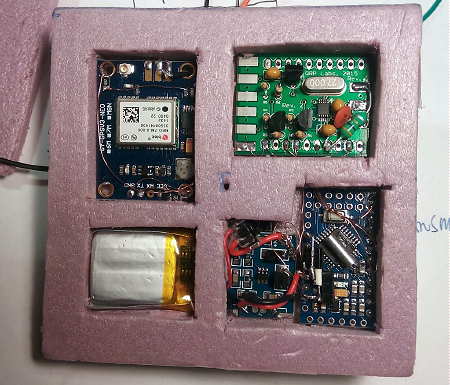
David, VE3KCL, used a special U3 firmware version of one of the kits available from QRP Labs and an Arduino Nano board driven by a QRP Labs Si5351A Synthesizer board. Special WSPR codes were used for vehicle telemetry which sent Callsign, Power, Locator, Altitude, Temperature, Battery, Groundspeed, GPS Status and Satellites Found. A 30m HF data download link was used with the help of a full-sized dipole hung between the system's two support balloons as well as a CW identifier on several other bands.
Hans describes the system used:
David VE3KCL launched his third balloon flight S-3 on 28-Jul-2015 at about 11:40Z. Like the former S-2 flight, this one also uses a special U3 firmware version on an Arduino Nano board, with QRP Labs Si5351A Synthesiser. Two foil "party" balloons were used, filled with hydrogen. The earlier balloons S-1 and S-2 apparently suffered burst failure before reaching float altitude due to polluted gas mix - there was a lot of propane mixed in with the hydrogen. This flight S-3 successfully climbed to almost 8,000m so this problem is now solved.
The transmission schedule includes CW on several different bands (for the reverse CW network), 30m JT9 and a special WSPR message on 30m. The special WSPR message types encodes two additional WSPR messages which contain the additional 5th and 6th character of the locator, altitude, battery voltage, temperature, ground speed, GPS status, and number of GPS satellites (a single bit, 0 means under 8, and 1 means 8 or more). The "special" WSPR transmissions therefore show up in the WSPR database with locators and powers which are not the actual locator and power, but encode the additional data. The conversion back to actual flight data is done later in an Excel spreadsheet. This is very experimental at the moment.
FYI VE3KCL's S-3 balloon survived the night, woke up at around 1100Z when daylight restored power to the solar cells and the battery changed a bit. It is currently cruising at 7,660m in locator FN20DD, about 50km North-West of Philadelphia, US.
 |
| courtesy: VE3KCL, GØUPL and https://www.google.ca/ |
I will update the map and data graphs at the end of the day.
73 Hans G0UPL
 |
| courtesy: VE3KCL and http://www.qrp-labs.com/ |
More information and pictures of VE3KCL's adventures can be viewed on the QRP Labs website. For those who are software-savvy, it looks like a simple system could be put together with some of the available kits.
PS-46 UPDATE
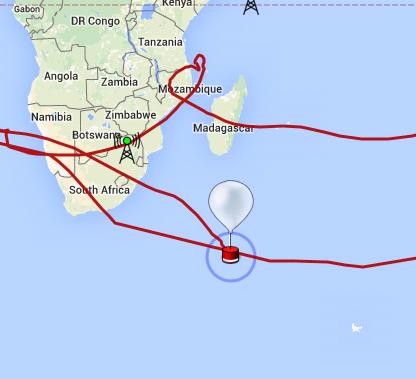
On another note, it does appear that Andy's amazing Pico-Sat balloon did indeed go down, south of Madagascar, after almost completing its 3rd circumnavigation of the globe.
 |
| courtesy: http://spacenear.us |
The Joy Of CW
 |
| courtesy: http://www.arrl.org/ |
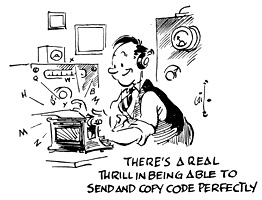
I receive a lot of e-mail from both hams and future hams that are struggling with CW. It seems there are a lot of hams that don't operate any CW simply because of their code skills. For myself, learning CW as a pre-teen, was a bit of a struggle, as I learned CW from flash cards ... definitely the wrong way. In my case, the code was learned in order to operate an Aldis lamp signalling system for my scouting activities. When eventually switching to a hand key and buzzer, I had to make the mental switch between the picture of the flash card and the sound of the code, taking me much longer to reach my goals than if I had learned just by sound.
If I were learning the code today, or if advising anyone struggling with CW, I would suggest several ways of making it easier.
1. Too many newcomers want to learn CW using a keyer. Put the keyer away and get yourself a hand key. It need not be fancy or expensive.
2. Use the hand key to practice sending similar-sounding letters (E, I, S, H etc) slowly and correctly. Don't be concerned about sending them fast but concentrate on getting a uniform spacing between each element of the letter. As you slowly learn the letters and how they sound, you will find your sending speeding-up, unconsciously, as you progress.
3. Combine your sending practice with receiving practice and try to do 10 minutes of each during each practice session. One session per day will guarantee success, if you stick with it. If you can't do it every day then try and commit to every other day.
4. For receiving practice, use a much higher speed than what you are sending at. Once again, in sets of similar-sounding letters, try and learn the letters when sent at a speed of at least 15WPM, but with wide spaces between each letter ... so they aren't coming at you as fast. This is the Farnsworth method of learning code. Learning what the letters sound like when sent at a fast speed will eliminate the dreaded 'learning plateaus' associated with learning at slower speeds, when you can get stuck at a lower speed for some length of time. I only wish that I had known of this method when I was a kid, but I don't think it had been thought of back then.
5. There are lots of websites that will help you in Step 4 and one that I have played with seems to work very well. You can set up a slow-speed spacing but have characters sent at 15WPM or faster (start with 15WPM). You can pick only the letters that you wish to practice (T,M,O,A,N etc) and then get a printout of what was actually sent to check your accuracy. The one I tested is by AA9PW and can be found here.
In addition, the ARRL's W1AW, provides nightly code practice on various frequencies and also provides archived CW practice sessions at various speeds via their website here.
Once you become somewhat competent in both sending and receiving, don't be afraid to get on the air and use your new skills. Don't be concerned about sending fast and be careful about sending faster than you can receive, an easy trap to fall into.
There are always several stations around 7.110-7.125 every afternoon and evening that seem very happy to communicate at comfortable speeds. If you don't get on-the-air, then make sure that you still do your daily 20 minutes of practice. You will be amazed at how quickly you can learn the code or increase your speed, with this daily routine. This short daily commitment to practice (on the air or otherwise) is the key to success.
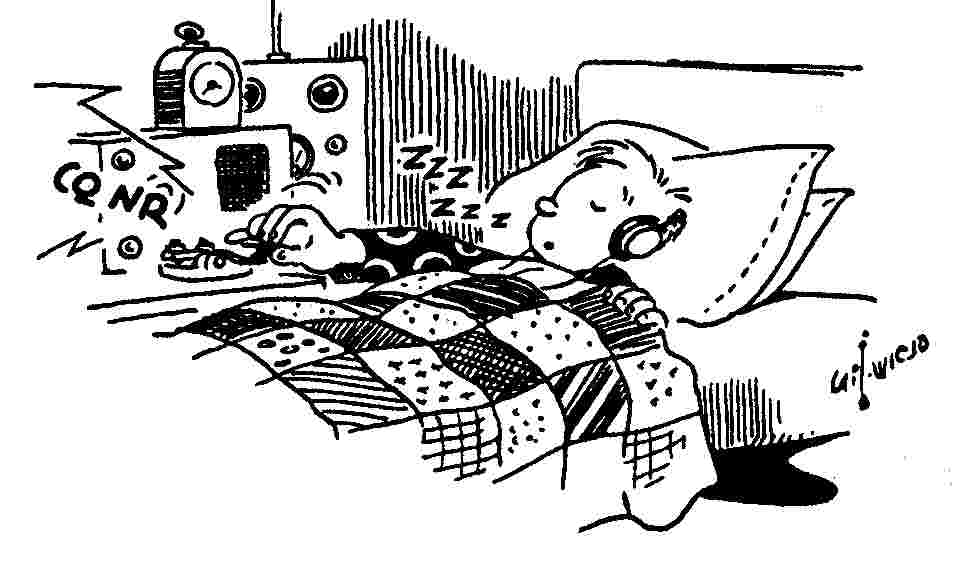
If you aren't using CW, you are missing out on a lot of fun. To this day, CW is still my favorite mode and almost 100% of my on-air operating is on CW ... it's just plain fun! Knowing how to use CW will open up a lot of opportunities to enjoy it ... CW contesting, chasing DX, CW nets, staying in touch with friends etc ... CW will always get through better than phone under most conditions.
 |
| courtesy: http://www.arrl.org/ |
So ... if you have been struggling with the code, or putting it off, there's no time like the present to join the fun. Hopefully you will find these suggestions helpful.
6m SSSP JA’s
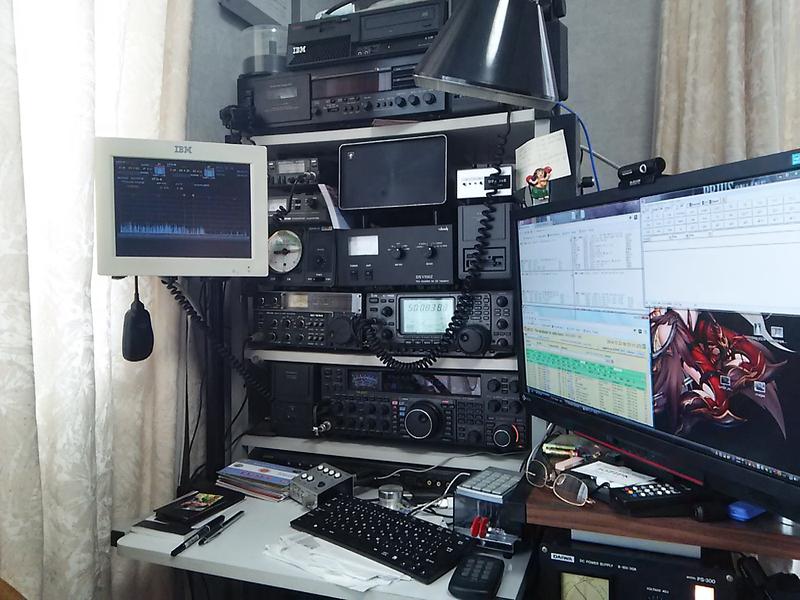 |
| JA7DYN's Station |
Six meters delivered a mid-afternoon surprise yesterday, with a brief opening between the west coast and Japan. It was one of those openings that would have been missed entirely, a few years ago.
At around 2300Z, JE1BMJ (Han), announced via the ON4KST 50MHz chat page that he would be CQ'ing towards North America on 50.090KHz. I was working at the bench with the receiver running in the background and took a moment to turn my 4el yagi towards Japan and put the receiver on frequency. Nothing was heard for several minutes when, as if a switch had been thrown, the frequency became alive with CW sending "... DX K". About 20 seconds later it started again, a CQ DX from JE1BMJ. It is amazing how often the band or a path will appear to suddenly open, in this case, at just the tail end of Kas's CQ ... not a whisper of anything before the very tail end. As I listened, his signal built from the initial 559 to 579 at which point I called and we exchanged signal reports.
I moved down the band and called CQ DX and was immediately called by several loud JA stations. Over the course of the short opening (just 15 minutes from start to finish), I worked the following stations in Japan:
JE1BMJ
JA1VOK
JR2HCB
JF1UMK
JAØRUG
JM1IGJ
JG1TSG
JHØKHR
JF1IRW
JA7DYN
JK1EXO
As mentioned earlier, this was an opening that would probably have been missed a few years ago, for several reasons. One factor is the growing use of the Internet to spot activity or stations that are actually on-the-air in real time. Another reason is the very short window of opportunity. Without stations looking, thanks to Han's QRV announcement, it is probable that nobody would have been pointing towards Japan at that time of the day ... but, more likely, the biggest reason is the exploitation of the SSSP path between NA and Asia that has become somewhat of a regular occurrence over the past several summers.
SSSP or Short-path Summer Solstice Propagation is the mechanism uncovered by JE1BMJ in 1999. In that year he discovered that his signals could be heard almost daily in many parts of Europe by transmitting on a regular evening schedule. He then turned his attention to North America, in the morning, and found much the same thing. Han continues to this day on a regular schedule each day and more often than not, works several stations in North America ... from both coasts and everything in between. He has even worked into Central America on SSSP.
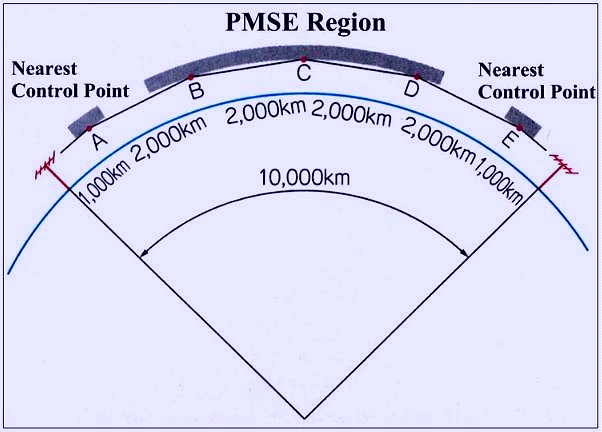
SSSP is a summertime-only event in the northern hemisphere and relies on the scattered ice crystals found in the Polar Mesospheric Summer Echo region (PMSE), located about 88km above the ground, very near the same height as the E-layer.
 |
| courtesy: JE1BMJ |
Signals travel through the polar region and never touch the ground until the far end of the path is reached. In all probability, this is the same mechanism that west coast stations are able to work transpolar-Es into Europe during the summer. The season is short-lived (June/July) and openings can have weak rapidly fading signals or, as in yesterday's case, strong steady signals during the course of the opening. Openings can last from just a few minutes to several hours. Thanks to the Internet and real-time chat, most of these openings are no longer being missed.
Stations being worked via SSSP seem to be, for the most part, running high-power and / or large antenna systems. It is rare to work many of the 100 watt stations, although under good conditions, it does happen.
 |
| JR2HCB's 6m Yagi Stack |
Vatican Magic
 |
| courtesy: K7CW |
June 21st was one of the better days of this year's poor Sporadic-E season. Stations in the western part of North America had an early-morning opening to the Caribbean as well as to South America, when YV1KK was worked by stations in the PNW region.
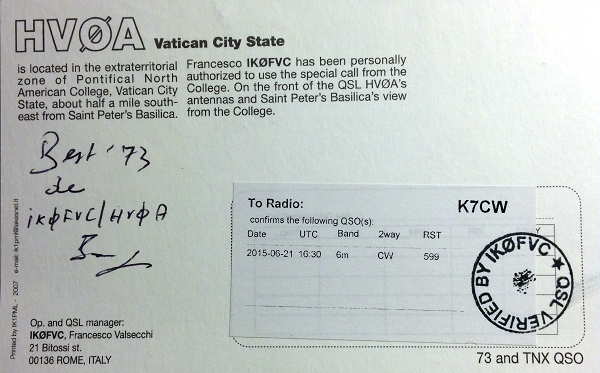
Here's how it happened here. I hadn't been paying attention to it, but N5DG had worked HVØA. Somebody mentioned that HVØA was going to QSY to 50.078 and was going to be looking for NA. I thought this choice of frequency was odd because some Europeans are not authorized to use frequencies below 50.080. But, I decided to go down there and check it out, because doing that has often paid off (re the CYØX QSO which brought me to start doing this). The propagation to the Caribbean and northern South America was demonstrably quite good (I worked my first YV), so checking out this European spot made even more sense.
I swung my beam up to a heading that I thought was good enough for Italy and tuned down on .078. Fortunately, there were no beacons coming through on that frequency, so I could concentrate on digging out any weak signal that was there. I slowly tuned around .078 and, for a while, heard nothing. After a few minutes, I began to sense that there was some tonal quality to the noise (musical noise). It was just there as no more than a hint, but I slowly tuned it so that it matched the frequency of my CW sidetone. I hoped that the other station (if there was one) would also have his filters set the same way. When I thought I had it about right, I switched in all my CW filters to the tightest setting (50 Hz) on both my transceiver and also my JPS NIR-12 outboard DSP filter. When I did this, the signal to noise ratio improved so well that I immediately started copying, "CQ NA CQ NA de HVØA HVØA" He was solid copy, but I needed those tight filters. I got his attention on the first call! He called me back using K8CW and gave me 599. I'm sure he was receiving me well, but probably didn't believe I was a 7. He kept calling me K8CW and I kept correcting him. I gave him a 599, too, but it was just a jerk-knee response that someone might do upon being the object of a miracle. But he was solid copy. After our QSO, I stopped hearing him. I logged him at 1631Z. The spotting record shows that N5DG and K7CW were the only North American stations to work HVØA on June 21 on 50 MHz. So, that's my side of the story.
 |
| courtesy: K7CW |
No magic for me that day but kudos to Paul and his fine station, as well as to Francesco, for the heads-up operating and being on top of the short propagation window that morning!
 |
| courtesy: K7CW and https://www.qrz.com/ |
These are the moments that 6m diehards live for, especially those on the west coast ... reminding us once again why the 'magicband' deserves its well earned moniker.
Remotes
 There has been a lot of discussion lately regarding the upcoming ARRL's review of DXCC requirements regarding, amongst other things, the use of "remote" stations. It seems that most folks are either dead against them or all for them, with little middle-ground. But one thing is for certain ... remotes are here to stay and are growing by leaps and bounds.
The biggest controversy seems to be whether DX worked via a remote should count the same as DX worked from one's home station. Many think that DX worked via a remote should still be countable for your DXCC credits but should be in a separate class or have a separate endorsement indicating such ... others see no separation is needed.
I guess a lot depends on how one views the DXCC program overall. Some see it as a competition against other stations while others view it is a personal challenge for one's own satisfaction and the only competition is with one's self.
For example, if a New England 160m amateur spends many years perfecting his system and struggles for those hard-fought Asian or South Pacific contacts, should these contacts be held in the same regard as the New Englander's 160m neighbour who works all of the Asian-Pacific with ease via a remote station on the west coast? Should both DXCC certificates be the same? There is also the question of remote stations "for rent" and the overall ethics or "legality" of such within the amateur radio service.
The only direct exposure I have had to remote station operation is hearing what was clearly an east-coast remote being operated by an amateur on the west coast, while working Europeans. No problem with that, however, the operator was giving his location as CN87, Washington state ... clearly deceptive, as many Europeans were delighted to think that they had just worked a new state in "7-land"!
I suppose that no matter how strict the "rules" for remote operations eventually become, there will always be those willing to play by their own rules, as is human nature.
The genie is out of the bottle and there is no going back. I think the ARRL has some tough decisions to make ... hopefully they will be well-thought out and not based solely on financial interests.
Updates
I have added a 'Quick Links' section along the right side of my blog. Here you will find links to noteworthy blogs on my site without having to sleuth through the entire listings. Those of you reading my blog on amateurradio.com will not see these but they can be viewed on my actual blog page here.
Now that my two major outdoor summer projects have been done, the re-roofing of my yard shed as well as the woodshed roof, I can get back to concentrating on more benchwork soon.

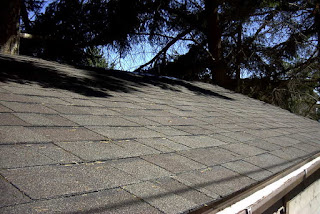
The hardest part of the roofing job was stripping the old cedar shakes (23 years old) and then sheathing the roofs with plywood. The actual laying of the new asphalt shingles (Malarkey) went very quickly. This was my first exposure to shingling and I learned a lot ... hopefully growing some new brain cells in the process. It's a good thing that 6m hasn't been open much at all this summer as I'd still be up on the roof.
 I've just checked the progress of Andy's PS-46 'PicoSat' balloon. It left the east coast of South Africa several days ago, streaking towards the Indian Ocean at 40,000 feet ... however it has not been reported for two days now.
When last heard it was 500km south of Madagascar heading SE. It had maintained 27,000 feet after leaving the African coast but then suddenly starting losing altitude over a 7 hour period. It was at 6,000 feet on the last report.
Hopefully PS-46 is just in a radio-quiet zone in the south Indian Ocean and will pop-up again as it nears Australia. It was well on the way to completing its third circumnavigation of the planet but one wonders just how long PS-46 can go on.
Now that my two major outdoor summer projects have been done, the re-roofing of my yard shed as well as the woodshed roof, I can get back to concentrating on more benchwork soon.


The hardest part of the roofing job was stripping the old cedar shakes (23 years old) and then sheathing the roofs with plywood. The actual laying of the new asphalt shingles (Malarkey) went very quickly. This was my first exposure to shingling and I learned a lot ... hopefully growing some new brain cells in the process. It's a good thing that 6m hasn't been open much at all this summer as I'd still be up on the roof.
I've just checked the progress of Andy's PS-46 'PicoSat' balloon. It left the east coast of South Africa several days ago, streaking towards the Indian Ocean at 40,000 feet ... however it has not been reported for two days now.When last heard it was 500km south of Madagascar heading SE. It had maintained 27,000 feet after leaving the African coast but then suddenly starting losing altitude over a 7 hour period. It was at 6,000 feet on the last report.
Hopefully PS-46 is just in a radio-quiet zone in the south Indian Ocean and will pop-up again as it nears Australia. It was well on the way to completing its third circumnavigation of the planet but one wonders just how long PS-46 can go on.













