Author Archive
 Sparking-Up On 2200m
 August 29th, 2015 |
  Author: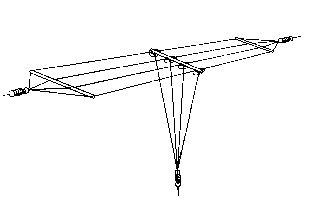
An e-mail alert from Toby, VE7CNF, on the other side of Georgia Strait, indicated that everything was ready for a two-way test on 2200m and he was looking for his initial contact on the band. Having not been on the band for such a long time, some review of my 'tune-up' procedures were in order as well as the need to burn out the spider webs in my outdoor loading coil.
Since being on 2200m, I had modified my 2200m kilowatt transmitter so that it could also be used on the new 630m band. To change bands from 630m back to 2200m, I needed to swap the frequency-sensitive power divider back to 2200m as well as re-set the DDS frequency.
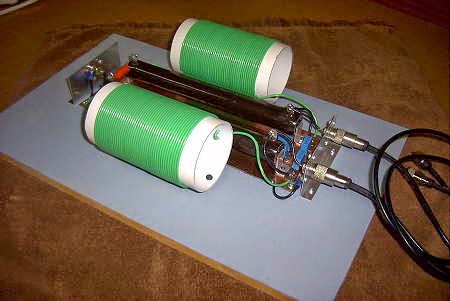 |
| 2200m Power Divider |
When modifying the transmitter, three years ago, I had also changed the transmitter's input frequency divider from a 'divide-by-four' to a 'divide-by-two' scheme. My original system on 137KHz started with a DDS frequency in the 5.48MHz range and then was divided by ten before being fed to the transmitter's input where the 548KHz signal was then divided by four. Using a higher DDS frequency allowed for greater frequency resolution at 2200m and allowed for very small frequency adjustments across the band. I would have kept the same system for 630m except that my 'divide-by-ten' chip was not very happy at 18MHz and refused to divide.The newer system now only allows me to move around the band in 4.5Hz steps. It's really not much of a problem as there is presently a minuscule amount of activity in Canada on 2200m, but as previously mentioned, this may change when U.S. amateurs gain access to the band.
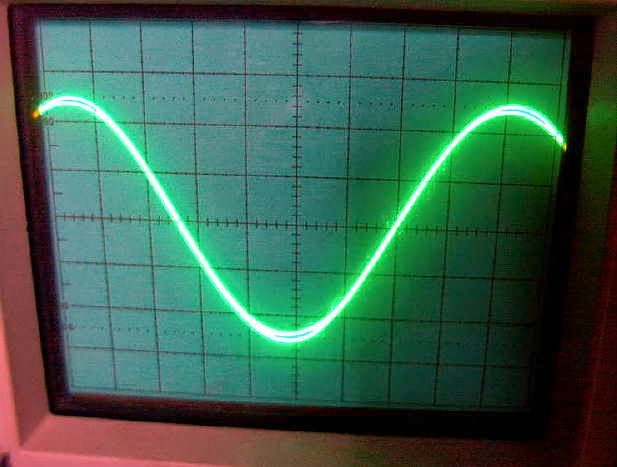
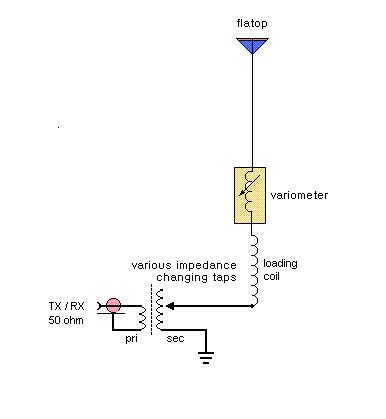
Having sorted out my transmitter problems and confirming that all was well, the next task was to check antenna resonance and impedance matching as it would more than likely not be the same as I had left it. A low-power check using the 'scopematch' indicated that both resonance and impedance were not optimized. Tapping down on the loading coil by one-turn took care of resonance while adjusting the impedance tap in my matching transformer to its lowest value (see matching scheme below) resulted in a near perfect match on the scope.
I'm guessing that the resonance change was due to the recent heavy trimming of the 80' Balsam that supports one end of my 'inverted-L' and large three-wire flatop.
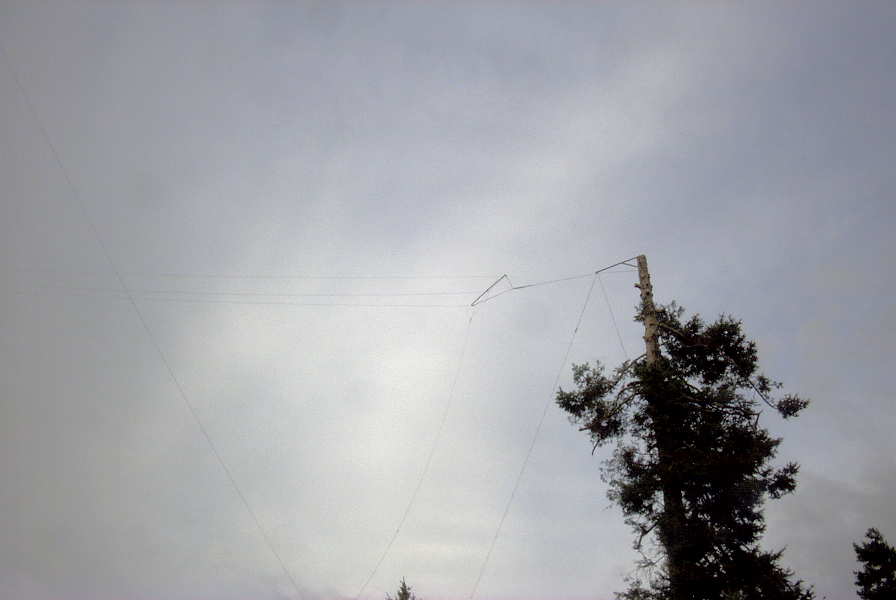
The tree's crown had previously been very dense and some of the branches were almost touching the flatop. The close proximity always made me worry about possible flashover at the antenna ends as voltages here would be several kilovolts. Removing much of the wet green tree branches directly beneath the flatop also likely contributed to the slight change in resonance.
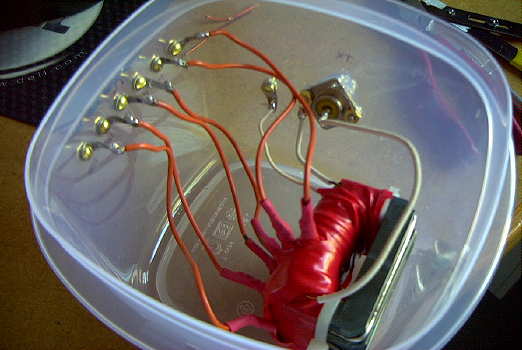 |
| Impedance Matching Transformer On TV Flyback Cores |
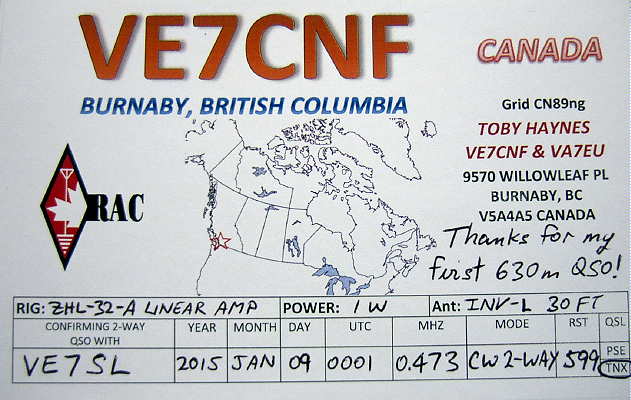
The sked with VE7CNF went smoothly and it was nice to see another new Canadian station taking an interest in the band, along with all of its challenges. Toby's 200W signal was a solid 559 here even with his small antenna system yet to be fully optimized. As well, he was bothered by heavy switching-power supply QRM from a nearby neighbour. Unfortunately, such noise sources seem to be increasing in numbers and are making operation on LF, already a big challenge, even more challenging. Toby has taken up the challenge with enthusiasm and has now had contacts on 2200m well as on 630m, adding to the ranks of active VE7's on LF and ... demonstrating yet again that amateurs can enjoy the LF bands with small 'backyard' antenna systems. Don't let living in the city be a reason to avoid our new LF bands.
Wouldn't it be great to see some activity from our neighbours in VE6 or VE5, both easily workable on both bands from the west coast... maybe you're up to the challenge!
Tuna Tin Fun
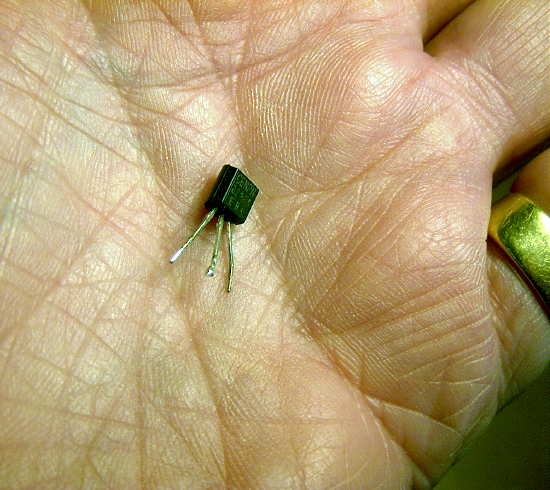
I was doing a little housekeeping in the shack this past week and ran across small piece of anti-static foam with a transistor sticking out of it. It was the transistor from my Tuna Tin II final amplifier's stage ... the actual transistor that I had used to 'Work All States' on 7040KHz using my Tuna Tin back in 2000. Looking at it in my hand brought back a lot of wonderful memories from the fall of that year when I spent so much of my time looking for new states.
Like many others at the time, I was swept up in the second 'Tuna Tin revolution' when the NorCal QRP Club released a very inexpensive kit for the Tuna Tin II. It turned out to be the best $13 I had ever spent on ham radio bits as it brought me so much operating fun while making many new acquaintances in the process.
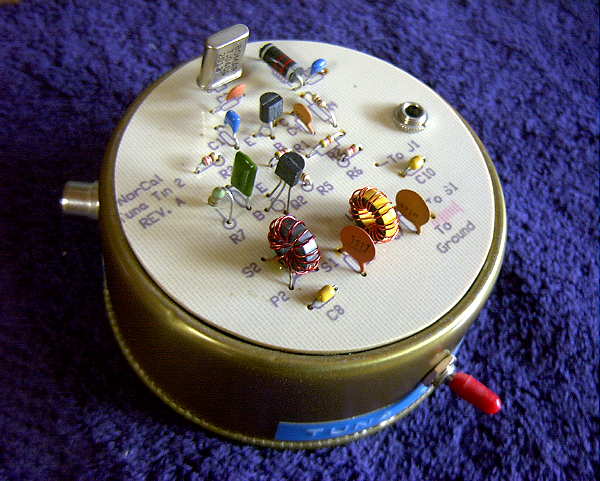
I recall the afternoon that I completed the kit ... attaching my antenna and calling 'CQ' on 7040 with a hand key plugged into the Tin. My afternoon call brought an immediate response from a station in Oregon who gave me a 579 report! Needless to say I was elated that it's ~360mw had done so well.
Over the next few days I worked a few more stations in the western states even stretching out to northern California and had pretty much decided that most of my QSO's with it would be fairly short range ... until the pre-dawn hours of August 6th when my hand-keyed 'CQ' was answered by NØTU (Steve), in Colorado! We had a nice solid ragchew until we ran out of darkness but the contact had given me re-newed optimism. If I could get a decent signal into Colorado, then perhaps I could actually work further afield ... maybe it was even possible to work all 50 states!
With that, I set myself a goal of trying to work them all. Although my 40m half-sloper was well matched and had proven to be a good performer in the 40m pileups, it only had four buried radials. The first thing I did was to bury another 30 radials around the base of the 48' tower, hoping to lower my ground losses as much as possible. With just one-third of a watt, there was no power to waste.
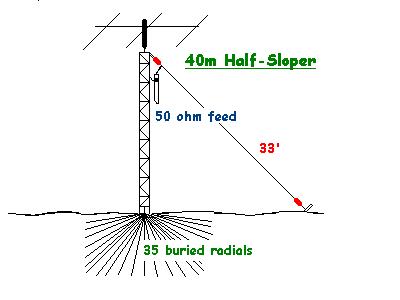
Back in those days, I was still working and could only get to the Mayne Island QTH on weekends. With the Friday night ferry arriving at around 8PM, by the time the woodstove had been fired-up and dinner taken care of, I very often didn't get to the Tuna Tin until around 11PM. As it turned out, the late hour operation worked out well and it didn't take long for my state total to climb. The toughest states were the New England '1's and as I neared the end, I still needed several. In late November, 40m revealed its magic-side and an early-evening 'CQ' brought replies from three W1's, all at once, each one a new state. Finally, in early December, I worked Wyoming for state number fifty!
The fifty QSL's were duly gathered and sent to the ARRL for an official "WAS" award. Although there was no special endorsement for the Tuna Tin, other than for 'QRP', there was a nice note about it in the 'ARRL Letter' as well as in QST:
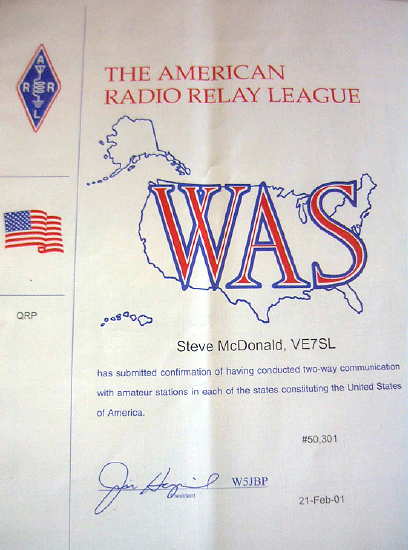
First Tuna Tin 2 WAS claimed: When the Tuna Tin 2 low-power transmitter article appeared in QST in 1976, its author Doug DeMaw, W1CER (later W1FB), envisioned it as a weekend project that could be used for short-range contacts.
Now, a quarter of a century later, a Canadian amateur has claimed the first Tuna Tin 2 Worked All States Award! Steve McDonald, VE7SL, got caught up in "Tuna Tin 2 Mania" and bought one of the popular TT2 kits. After working about 30 states with the little rig, WAS suddenly seemed plausible. McDonald realized his dream several months later when he turned in his cards for WAS. All contacts for the award had been completed while he was running about 400 mW from a Tuna Tin 2. As far as the ARRL awards folks know, this marked the first time WAS was achieved with a Tuna Tin 2--although there is no special endorsement for having done so. "Doug DeMaw knew in his heart that the rig would be useful and popular, but I don't think he ever envisioned that this little transmitter would still be working its QRP magic over 25 years after it first appeared in the pages of QST," said ARRL Lab Supervisor Ed Hare, W1RFI--himself a QRP and TT2 aficionado who has promoted the Tuna Tin 2 Revival and was McDonald's Connecticut contact for WAS. Congratulations to VE7SL on a tremendous operating accomplishment.--Ed Hare, W1RFI
Holding the battle-scarred 2N2222 in the palm of my hand reminded me of just how much excitement can be had with just a few simple parts and the magic of radio.
CLE197 Results
 It seems that our medium-frequency NDB CLE's (Co-ordinated Listening Event) go hand-in-hand with solar disturbances and wacky geomagnetic conditions. If you want to know when the next big geomagnetic upset will be, just check the date of the next CLE!
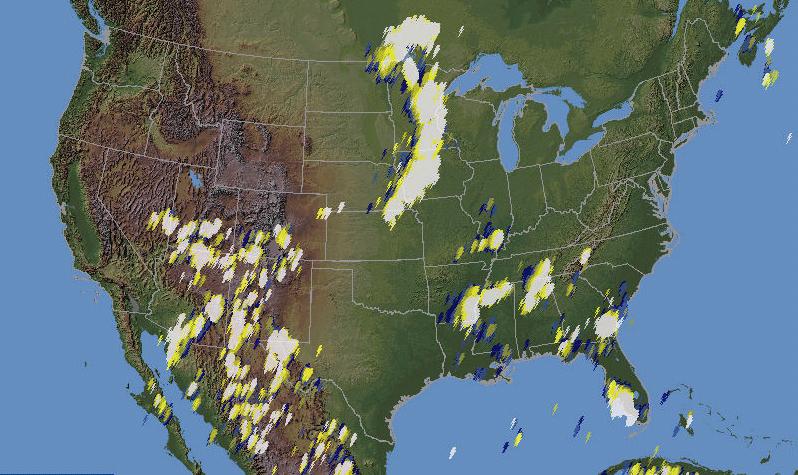
Along with a half dozen M-flares and auroral-producing 'K' indexes of 5-6, most of North America was blanketed with severe thunderstorm activity, always typical of this time of the year. In spite of the poor conditions, several signals did manage to find their way into my log. Sunday night provided the best conditions, with far less thunderstorm activity and a slight improvement in propagation. Saturday night's lightning map looked like this:
 |
| courtesy: http://thunderstorm.vaisala.com/explorer.html |
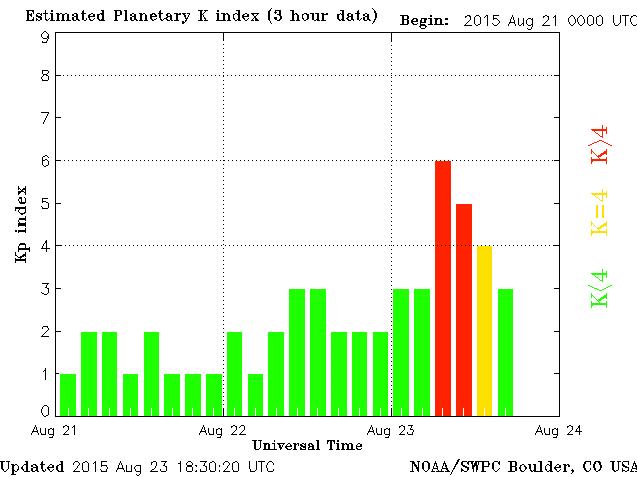 |
| courtesy: http://www.noaa.gov/ |
Loggings in RED where made on Friday night, GREEN on Saturday night and BLUE on Sunday night.
All stations were heard on the Perseus SDR while using my LF 'inverted-L' resonated at 300KHz.
LOG:
DD UTC kHz Call mi Location
---------------------------------------------------------------------------
22 06:00 240 BVS 48 Burlington, WA, USA
22 10:00 241 YLL 648 Lloydminster Municipal Apt, AB, CAN
22 12:30 242 ZT 223 Port Hardy, BC, CAN
22 10:00 242 XC 342 Cranbrook, BC, CAN
22 10:00 244 TH 1166 Thompson, MB, CAN
23 07:00 245 YZE 1890 Gore Bay, ON, CAN
22 12:00 245 HNS 865 Haines, ALS
24 09:00 245 FS 1311 ROKKY - Sioux Falls, SD, USA
22 10:00 245 CRR 821 Circle Town County Apt, MT, USA
24 05:00 245 CB 1528 Cambridge Bay, NU, CAN
23 12:00 245 AVQ 1298 Marana Regional Apt, AZ, USA
22 09:00 246 ZXJ 517 Y'Taylor' Fort St. John, BC, CAN
22 09:00 248 ZZP 486 Dead Tree - Queen Charlotte Is, BC, CAN
22 09:00 248 QL 471 Lethbridge, AB, CAN
22 09:00 248 QH 811 Watson Lake, YT, CAN
22 09:00 250 FO 1002 Flin Flon Municipal Apt, MB, CAN
22 12:30 250 2J 220 Grand Forks Municipal Apt, BC, CAN
22 09:00 251 YCD 32 Nanaimo, BC, CAN
22 09:00 251 PWD 850 Plentywood, MT, USA
22 12:30 251 OSE 1708 Oscarville - Bethel Apt, ALS
23 11:30 251 AM 1445 PANDE - Amarillo, TX, USA
24 08:00 253 GB 1324 'Garno' Marshall, MN, USA
22 09:00 254 ZYC 441 Calgary, AB, CAN
22 09:00 254 SM 891 Fort Smith, AB, CAN
24 11:30 256 TQK 1322 Scott City Municipal Apt, KS, USA
22 12:30 256 LSO 188 Kelso - Rocky Point - Kelso, WA, USA
22 12:00 256 EB 537 Namao - CFB Edmonton, AB, CAN
22 09:00 257 XE 757 Saskatoon, SK, CAN
24 09:00 257 SAZ 1329 Staples, MN, USA
22 09:00 257 LW 192 Kelowna - Wood Lake, BC, CAN
22 09:00 258 ZSJ 1324 Sandy Lake Apt, ON, CAN
23 08:00 420 FQ 1422 MONTZ - East Chain, MN, USA
24 09:00 428 POH 1433 Pocahontas Municipal Apt, IA, USA
22 12:00 429 BTS 1571 Wood River - Dillingham, ALS
24 09:00 434 SLB 1410 Storm Lake Municipal Apt, IA, USA
------------------------------------------------------------------------------------
Thankfully, by this time next month and into October, quieter nights and better propagation will prevail ... fall often produces the best propagation of the year and has always been my favorite time of the year, outdoors and at the dials.
Another VE3KCL Balloon Adventure
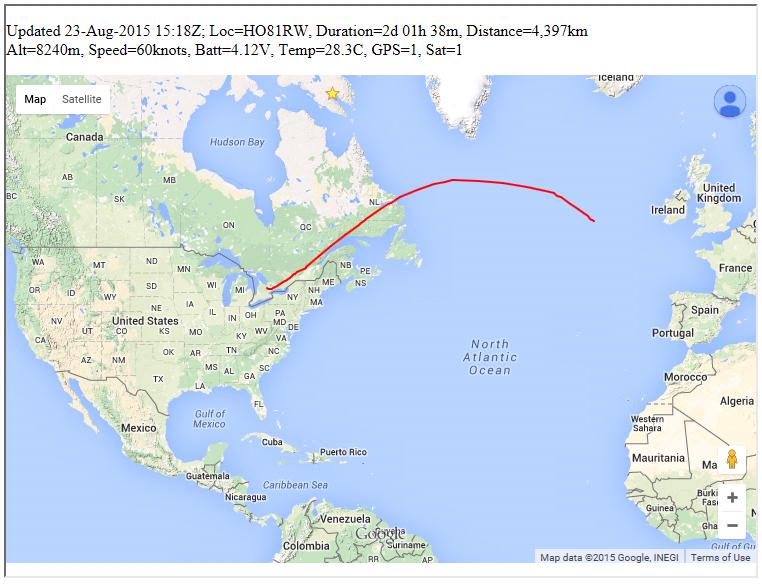 |
| courtesy: http://qrp-labs.com/ and https://www.google.ca/maps/ |
Like earlier flights, 'S-4' also uses a special U3 firmware version on an Arduino Nano board, with a QRP Labs Synthesiser, along with two hydrogen-filled party balloons with HF antennas hung between them. You can read all about Dave's previous flights here and keep up on the balloon's track here.
The balloon is transmitting data regularly on the following schedule:
0:00 CW ID, and 22wpm CW on 30m, 20m and 17m bands
0:01 JT9 on 10,140,450: "#CS#AT" (callsign, altitude)
0:02 JT9 on 10,140,450: "#LT#A0" (latitude, temperature on analogue A0)
0:03 JT9 on 10,140,450: "#LN#A3" (longitude, battery on analogue A3)
0:04 JT9 on 10,140,450: "#M6#GS" (6-char Maidenhead locator, groundspeed)
0:05 JT9 on 14,078,450: "#CS_#M6" (callsign, 6-char Maidenhead locator)
0:06 WSPR on 10,140,250 (standard WSPR transmission)
0:08 WSPR on 10,140,250 with special data telemetry encoding
0:10 22wpm CW on 15m, 10m and 6m bands
0:11 Calibration
0:12 Repeat...
Frequencies to listen on are:
Minute Mode Tag Frequency (Notes)
00:00 CWID. 10.140450 (GPS off)
00:12 CW 05 10.139150
00:27 CW 05 14.100550
00:42 CW 05 18.109150
01:00 JT9 00 10.140450
02:00 JT9 03 10.140450
03:00 JT9 04 10.140450
04:00 JT9 01 10.140450
05:00 JT9 02 14.078450
06:00 WSPR. 10.140250 (normal WSPR)
08:00 WSPR. 10.140250 (encoded WSPR)
09:50 CW 05 21.150150 (GPS on)
10:05 CW 05 28.205150
10:20 CW 05 50.070150
10:35 QRSS. 10.140450 (continuous 'space')
10:55 calibration
12:00 restart the sequence
Let's wish Dave luck and hope that this one makes a successful circumnavigation. It would be the first by a Canadian amateur I believe.
Regen Wrap-Up … What’s Next

I've also published a new page on my website which contains more pictures and details of all phases of the project. The page also has a recording of the 40m CW band, made a few evenings ago, which really best demonstrates how the receiver is working.
In the meantime, much consideration has been given to the next project work ... it will be a return to my earlier lightwave experiments. During the recent visit here by Toby (VE7CNF) and Mark (VA7MM), both expressed interest in building some lightwave equipment (in fact ... 'parts' have been ordered!) to try some direct LOS work as well as to try some QRSS clear-air scatter / cloudbounce work. It's really exciting to see some new interest in this fascinating mode as the field for experimentation in both transmitting and receiving systems is quite vast.
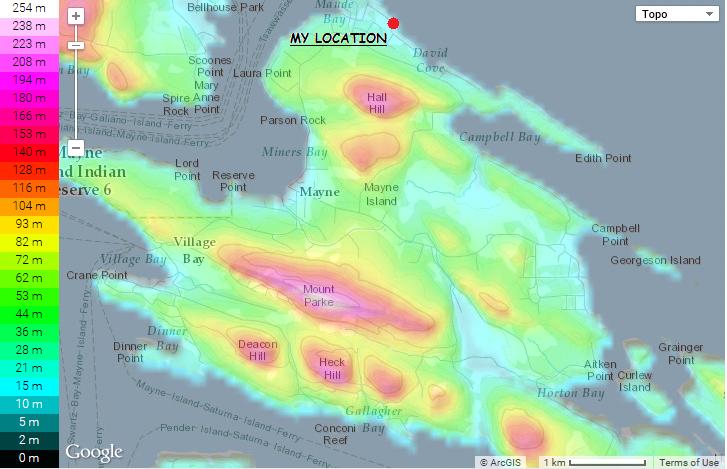
My first task will be to build a 4" optical tube receiver or another boxed Fresnel-lens type for portable operation, here on Mayne Island, to see if I can scatter a signal to the other side of the island and detect it while operating in the field. There are a couple of nearly 600' peaks on Mayne which should provide a good shielding effect for testing ... maybe too good. Time will tell.
 |
| courtesy: http://en-ph.topographic-map.com/ |
Hunting For NDBs In CLE 197
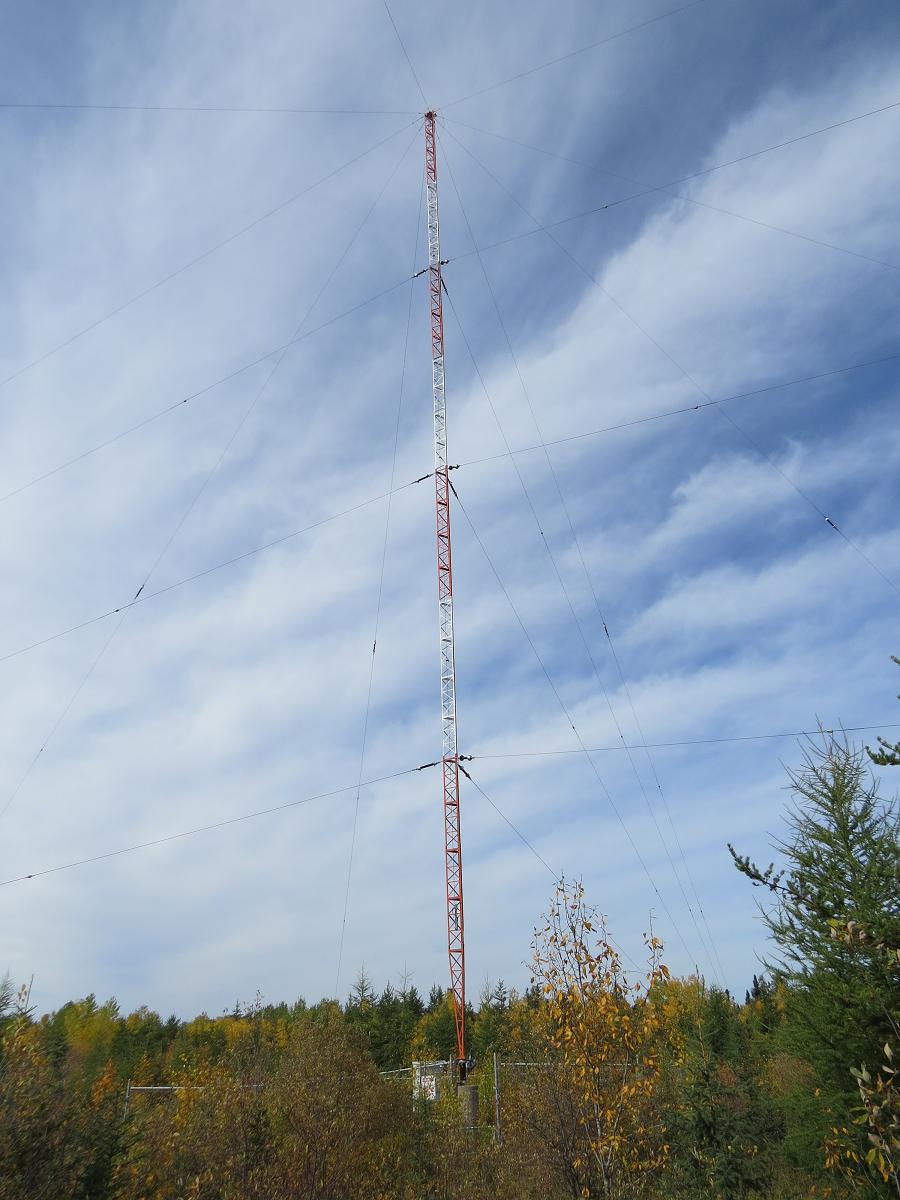 |
| 'ZSJ-258' Sandy Lake, ON |
A list of all of the North American targets in this range can be found in the RNA database, while targets for European DXers will be found here... specify the frequency range wanted and check 'show all results'.
An excellent target for this CLE is 'ZSJ', the Sandy Lake, Ontario NDB (258KHz) shown here. Its 500W signal and big antenna get out very well ... it has been heard in Europe as well as in Hawaii.
From CLE coordinator Brian Keyte (G3SIA) comes the following reminder:
Hi all,
Here are the final details for our 197th co-ordinated listening event this
weekend. First timer logs too? Yes, please!
Days: Friday 21 August to Monday 24 August
(that's a week earlier than usual)
Times: Start and end at midday, your LOCAL TIME
Range: 240.0 - 259.9 kHz plus 420.0 - 439.9 kHz
(BOTH ranges are for ALL listeners)
Please log NDBs that you can positively identify in the ranges, plus any
UNIDs that you come across there.
Send your CLE log to the List, if possible as a plain text email and
not in an attachment, with CLE197 at the start of its title.
Show on EVERY LINE of your log:
# The Date (or day 'dd') and UTC (the day changes at 00:00 UTC).
# kHz - the beacon's nominal published frequency (if you know it).
# The Call Ident.
Please show those main items FIRST on each line, then any optional details
such as Location, Offsets, Distance, etc.
If you send interim logs, do make sure that you also send a 'Final' log
containing all your loggings. As always, please make your log useful and
interesting to everyone by including your own location and brief details
of your receiver, aerial(s) and any recording equipment that you used.
I will send the usual 'Any More Logs?' email at about 17:00 UTC on
Tuesday so that you can check that your Final log has been found OK.
Do make sure that your log has arrived on the List at the very latest by
08:00 UTC on Wednesday 26th August.
I hope to complete the combined results later on that day.
You can find CLE-related information from the CLE page,
http://www.ndblist.info/cle.htm , including access to the seeklists
that have been made for the event from REU/RNA/RWW.
(NB: To also see a MAP of the seeklist NDBs around you, just change
'List' to 'Map', select 'All Results' and uncheck 'Clustering')
Good listening
Brian
----------------------------------------------------------
From: Brian Keyte G3SIA ndbcle'at'gmail.com
Location: Surrey, SE England (CLE co-ordinator)
----------------------------------------------------------
(Reminder: You could use any one remote receiver for your loggings,
stating its location and owner - with their permission if required.
A remote listener may NOT also use another receiver, whether local or
remote, to obtain further loggings for the same CLE).
Here are the final details for our 197th co-ordinated listening event this
weekend. First timer logs too? Yes, please!
Days: Friday 21 August to Monday 24 August
(that's a week earlier than usual)
Times: Start and end at midday, your LOCAL TIME
Range: 240.0 - 259.9 kHz plus 420.0 - 439.9 kHz
(BOTH ranges are for ALL listeners)
Please log NDBs that you can positively identify in the ranges, plus any
UNIDs that you come across there.
Send your CLE log to the List, if possible as a plain text email and
not in an attachment, with CLE197 at the start of its title.
Show on EVERY LINE of your log:
# The Date (or day 'dd') and UTC (the day changes at 00:00 UTC).
# kHz - the beacon's nominal published frequency (if you know it).
# The Call Ident.
Please show those main items FIRST on each line, then any optional details
such as Location, Offsets, Distance, etc.
If you send interim logs, do make sure that you also send a 'Final' log
containing all your loggings. As always, please make your log useful and
interesting to everyone by including your own location and brief details
of your receiver, aerial(s) and any recording equipment that you used.
I will send the usual 'Any More Logs?' email at about 17:00 UTC on
Tuesday so that you can check that your Final log has been found OK.
Do make sure that your log has arrived on the List at the very latest by
08:00 UTC on Wednesday 26th August.
I hope to complete the combined results later on that day.
You can find CLE-related information from the CLE page,
http://www.ndblist.info/cle.htm , including access to the seeklists
that have been made for the event from REU/RNA/RWW.
(NB: To also see a MAP of the seeklist NDBs around you, just change
'List' to 'Map', select 'All Results' and uncheck 'Clustering')
Good listening
Brian
----------------------------------------------------------
From: Brian Keyte G3SIA ndbcle'at'gmail.com
Location: Surrey, SE England (CLE co-ordinator)
----------------------------------------------------------
(Reminder: You could use any one remote receiver for your loggings,
stating its location and owner - with their permission if required.
A remote listener may NOT also use another receiver, whether local or
remote, to obtain further loggings for the same CLE).
These listening events serve several purposes. They:
- determine, worldwide, which beacons are actually in service and on-the-air so the online database can be kept up-to-date
- determine, worldwide, which beacons are out-of-service or have gone silent since the last CLE covering this range
- will indicate the state of propagation conditions at the various participant locations
- will give you an indication of how well your LF/MF receiving system is working
- give participants a fun yet challenging activity to keep their listening skills honed
Final details can be found at the NDB List website, and worldwide results, for every participant, will be posted there a few days after the event. If you are a member of the ndblist Group, results will also be e-mailed and posted there.
The very active Yahoo ndblist Group is a great place to learn more about the 'Art of NDB DXing' or to meet other listeners in your region. There is a lot of good information available there and new members are always very welcome.
If you are contemplating getting started on 630m, listening for NDBs is an excellent way to test out your receive capabilities as there are several NDBs located near this part of the spectrum.
You need not be an ndblist member to participate in the CLEs and all reports, no matter how small, are of much value to the organizers. 'First-time' logs are always VERY welcome!
Reports may be sent to the ndblist or e-mailed to either myself or CLE co-ordinator, Brian Keyte (G3SIA), whose address appears above.
Please...do give the CLE a try....then let us know what NDB's can be heard from your location! Your report can then be added to the worldwide database to help keep it up-to-date.
630m Trans-Pacific Path Alive

In spite of the recent high levels of geomagnetic disturbance (or maybe because of it), just as it did last year at this time, the path between North America and Australia has sprung to life once again. Last night saw the reception of both WH2XND (NI7J), in Phoenix and WG2XXM (K5DNL), near Oklahoma City, by VK2XGJ in New South Wales, Australia. Not to be left out, VK2DDI, also in NSW, copied WG2XXM as well. Some of K5DNL's 630m gear can be seen here.
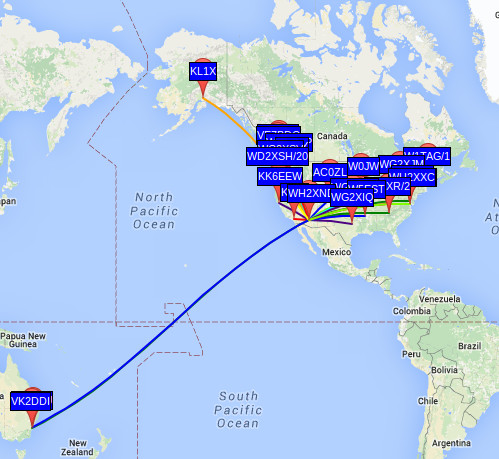 |
| courtesy: John Langridge (WG2XIQ / KB5NJD) |
The American beacons were operating in the WSPR mode, which has become very popular amongst 630m experimenters as well as those just interested in listening-in. WSPR is not a QSO mode but strictly a one-way 'beacon' mode. Although two stations may each spot each other, it is not considered to be a valid two-way QSO. A check of evening WSPR activity will often reveal dozens of stations actively spotting what they are hearing.
VK2DDI runs the Berry Mountain Grabber, providing other VK and ZL experimenters a handy way of checking their system progress or propagation conditions but during good T-P nights, it can be a good place for U.S. stations to watch for their signals as well.
If you have been doing any WSPR work on HF, you might be surprised at what you can hear down on 630m, even without a dedicated antenna for that band. Surprisingly good results can often be had with a non-resonant antenna as the signal to noise ratio can often be better even though signals may sound weaker. Give it a try and spot what you hear!
If you are interested in learning how to receive WSPR, here is a nice tutorial by ZS6SGM.
Should you be interested in knowing more about obtaining a Part 5 licence to transmit on 630m, John, KB5NJD / WG2XIQ, has a wonderful 630m resource page here, as well as more details about the recent down-under receptions. While there, be sure to check out his up-to-date 630m links page. He can be contacted via email or you can find him hanging-out most nights on the ON4KST kHz (2000-630m) chat page.
To keep on top of what is happening or who is on-the-air, most LF'ers rely on three sources:
- the RSGB LF Group reflector
- the Lowfer list
- the LWCA Message Board
Radio amateurs in Canada have had 630m as an amateur band since May of last year but unfortunately are not allowed to contact any of the experimental stations. Hopefully the U.S. will also obtain 630m as a ham band some time soon. In the meantime, a Part 5 licence for any U.S. amateurs would be a good way to be all set when that day eventually comes!













