Author Archive
 The May ‘Bug Roundup’
 April 30th, 2017 |
  Author:
 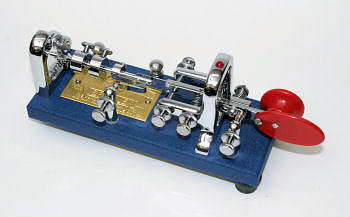 |
| Vibroplex "Blue Racer" |
Ever since earning my ticket as a teenager back in '63, almost all of my on-air activity has been focused on CW ... I've always loved it.
For my first year on-the-air, I used a nice brass hand key purchased locally for just a few dollars but once I had mastered that and I was just unable to send any faster with it, I purchased a Vibroplex 'Original', for, if memory serves me correct, around $40. I used it exclusively until building a homebrew memory keyer in the mid-70's and the Vibroplex saw little service for several years.
 |
| The Vibroplex 'Original' |
So much has changed now with the almost exclusive use of electronic keyers and everyone pretty much sounds the same, which is rather a pity I think.
Once my interest in building vintage-style vacuum-tube transmitters evolved, my interest in bugs was reactivated and over the years I have purchased a few more.
I'll do anything I can to promote and encourage the use of CW and especially hand-generated CW. That's why I was excited to read a recent e-mail from W6SFM, posted to several lists that I read, announcing the Bug Roundup!
The Samuel F. Morse Amateur Radio Club, a Sacramento, California based CW enthusiast club wanted a special time to bring bug operators together on the air. In the same spirit as ARRL's Straight Key Night, participants are encouraged to make simple, conversational, “chewing-the-fat”, "Rag Chew" QSOs using their bug type key. This is an opportunity to exercise, share and exhibit your personalized fist. This is NOT a contest. Simply Call "CQ BR" so folks know you are a Bug Roundup Participant. Grab that bug, clean those contacts, and let’er fly! Let’s hear that “Banana Boat / Lake Erie Swing" or that commercial KPH/WCC quality fist.
Reserve the day! Saturday May 20th - Sunday May 21st, 2017
7:00 AM to 7:00 AM Pacific Time (LOCAL)
1400 UTC through 1400 UTC
For more information, to register your station and key for participation, and to help assist in spotting, potentially increasing QSOs, an On-line chat window link can be found near the bottom of Bug Roundup home page located at http://www.w6sfm.com/Bug_Roundup.html We hope to hear you all on the air!
Reserve the day! Saturday May 20th - Sunday May 21st, 2017
7:00 AM to 7:00 AM Pacific Time (LOCAL)
1400 UTC through 1400 UTC
For more information, to register your station and key for participation, and to help assist in spotting, potentially increasing QSOs, an On-line chat window link can be found near the bottom of Bug Roundup home page located at http://www.w6sfm.com/Bug_Roundup.html We hope to hear you all on the air!
The May ‘Bug Roundup’
|
| Vibroplex "Blue Racer" |
Ever since earning my ticket as a teenager back in '63, almost all of my on-air activity has been focused on CW ... I've always loved it.
For my first year on-the-air, I used a nice brass hand key purchased locally for just a few dollars but once I had mastered that and I was just unable to send any faster with it, I purchased a Vibroplex 'Original', for, if memory serves me correct, around $40. I used it exclusively until building a homebrew memory keyer in the mid-70's and the Vibroplex saw little service for several years.
|
| The Vibroplex 'Original' |
So much has changed now with the almost exclusive use of electronic keyers and everyone pretty much sounds the same, which is rather a pity I think.
Once my interest in building vintage-style vacuum-tube transmitters evolved, my interest in bugs was reactivated and over the years I have purchased a few more.
I'll do anything I can to promote and encourage the use of CW and especially hand-generated CW. That's why I was excited to read a recent e-mail from W6SFM, posted to several lists that I read, announcing the Bug Roundup!
The Samuel F. Morse Amateur Radio Club, a Sacramento, California based CW enthusiast club wanted a special time to bring bug operators together on the air. In the same spirit as ARRL's Straight Key Night, participants are encouraged to make simple, conversational, “chewing-the-fat”, "Rag Chew" QSOs using their bug type key. This is an opportunity to exercise, share and exhibit your personalized fist. This is NOT a contest. Simply Call "CQ BR" so folks know you are a Bug Roundup Participant. Grab that bug, clean those contacts, and let’er fly! Let’s hear that “Banana Boat / Lake Erie Swing" or that commercial KPH/WCC quality fist.
Reserve the day! Saturday May 20th - Sunday May 21st, 2017
7:00 AM to 7:00 AM Pacific Time (LOCAL)
1400 UTC through 1400 UTC
For more information, to register your station and key for participation, and to help assist in spotting, potentially increasing QSOs, an On-line chat window link can be found near the bottom of Bug Roundup home page located at http://www.w6sfm.com/Bug_Roundup.html We hope to hear you all on the air!
Reserve the day! Saturday May 20th - Sunday May 21st, 2017
7:00 AM to 7:00 AM Pacific Time (LOCAL)
1400 UTC through 1400 UTC
For more information, to register your station and key for participation, and to help assist in spotting, potentially increasing QSOs, an On-line chat window link can be found near the bottom of Bug Roundup home page located at http://www.w6sfm.com/Bug_Roundup.html We hope to hear you all on the air!
LF / MF Antenna Planning
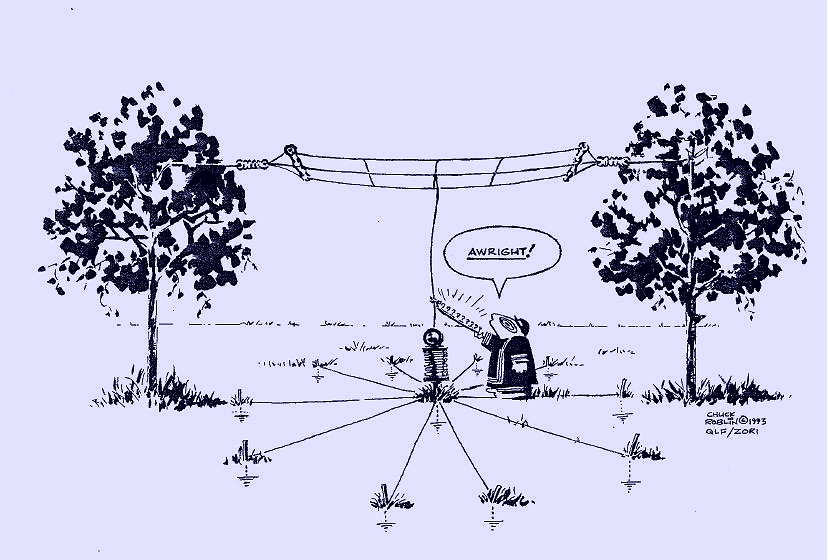 |
| courtesy: Chuck Roblin |
For U.S. amateurs, the 2200 and 630m bands will soon be a reality and I have no doubt that there will be an accompanying surge in interest among large numbers of homebrewers and low band diehards.
It should be an exciting time as new stations gradually start to populate the band from coast to coast.
High on the 'to do' list will be the planning and building (or modifying) of a suitable antenna system for the band(s) of choice. For most, this will be new territory, but the reality is that there has been a long tradition of operation in the LF and MF bands in the U.S. for many years ... all under the Part 15 'Lowfer' and 'Medfer' service.
Although activity in this category has fallen off over the years due to the availability of the much less-restrictive Part 5 experimental licences, there is still a great legacy of literature and information left behind that is every bit as useful today as it was back in the golden years of Lowfer operations.
Here is one such document from Stephen McGreevy's Natural ELF-VLF Radio website that many newcomers to these bands may find very helpful as it covers a wide variety of LF antenna-related basics in a down-to-earth manner.
An even more detailed treatise on virtually all aspects of LF and MF antenna topics is that found on Rik, ON7YD's website. His antenna pages can be found here. Although originally developed for the 2200m band, the principles are equally applicable to 630m as well.
Hopefully both of these sources will help you decide how to get a working antenna system up and running on the new bands. And as always, much help is available via the Internet on the Lowfer Reflector, the RSGB LF reflector or on the 600MRG Reflector.
LF / MF Antenna Planning
|
| courtesy: Chuck Roblin |
For U.S. amateurs, the 2200 and 630m bands will soon be a reality and I have no doubt that there will be an accompanying surge in interest among large numbers of homebrewers and low band diehards.
It should be an exciting time as new stations gradually start to populate the band from coast to coast.
High on the 'to do' list will be the planning and building (or modifying) of a suitable antenna system for the band(s) of choice. For most, this will be new territory, but the reality is that there has been a long tradition of operation in the LF and MF bands in the U.S. for many years ... all under the Part 15 'Lowfer' and 'Medfer' service.
Although activity in this category has fallen off over the years due to the availability of the much less-restrictive Part 5 experimental licences, there is still a great legacy of literature and information left behind that is every bit as useful today as it was back in the golden years of Lowfer operations.
Here is one such document from Stephen McGreevy's Natural ELF-VLF Radio website that many newcomers to these bands may find very helpful as it covers a wide variety of LF antenna-related basics in a down-to-earth manner.
An even more detailed treatise on virtually all aspects of LF and MF antenna topics is that found on Rik, ON7YD's website. His antenna pages can be found here. Although originally developed for the 2200m band, the principles are equally applicable to 630m as well.
Hopefully both of these sources will help you decide how to get a working antenna system up and running on the new bands. And as always, much help is available via the Internet on the Lowfer Reflector, the RSGB LF reflector or on the 600MRG Reflector.
CLE 218 Results
 |
| courtesy: https://sdo.gsfc.nasa.gov/ |
The 'Co-ordinated Listening Event' might more aptly be called the 'Cursed Listening Event' as once again the same large coronal hole (shown above) that has been present for several solar rotations seems to be more disruptive than ever. The subsequent higher than normal solar wind speeds causing widespread auroral conditions and elevated K indices have pretty much made a mess of MF and HF radio for the past several days.
 |
| courtesy: http://www.noaa.gov/ |
NDB-band recordings made with the Perseus SDR for the three-night event turned up very little activity other than a few strange hot-spots. Both 'OIN' in Kansas and 'CC' in California were strong on all three nights! Nothing from eastern Canada was heard and one of Alaska's strongest signals, 'ELF', was barely detected. Only the following few stations were logged:
23 08:00 341.0 ELF Cold Bay, ALS
22 06:00 338.0 ZU Whitecourt, AB, CAN
22 06:00 343.0 YZH Slave Lake, AB, CAN
22 04:00 344.0 YC Calgary, AB, CAN
22 12:00 338.0 RYN Tucson, AZ, USA
22 04:00 344.0 XX Abbotsford, BC, CAN
22 12:00 335.0 CC Concord, CA, USA
22 10:00 344.0 FCH Fresno, CA, USA
22 08:00 341.0 OIN Oberlin, KS, USA
22 04:00 344.0 BKU Baker, MT, USA
24 08:00 335.0 BK Brookings, SD, USA
22 04:00 347.0 PA Prince Albert, SK, CAN
22 08:00 338.0 K Port Angeles, WA, USA
22 04:00 348.0 MNC Shelton, WA, USA
22 05:00 341.0 DB Burwash, YT, CAN
I suspect the this same coronal hole will be with us for several more rotations ... perhaps it's time fool Ol' Sol and stagger our CLE's 28-day cycle so it doesn't continue go sync-up with poor band conditions but somehow I think that Murphy might not be so easily duped!
CLE 218 Results
|
| courtesy: https://sdo.gsfc.nasa.gov/ |
The 'Co-ordinated Listening Event' might more aptly be called the 'Cursed Listening Event' as once again the same large coronal hole (shown above) that has been present for several solar rotations seems to be more disruptive than ever. The subsequent higher than normal solar wind speeds causing widespread auroral conditions and elevated K indices have pretty much made a mess of MF and HF radio for the past several days.
|
| courtesy: http://www.noaa.gov/ |
NDB-band recordings made with the Perseus SDR for the three-night event turned up very little activity other than a few strange hot-spots. Both 'OIN' in Kansas and 'CC' in California were strong on all three nights! Nothing from eastern Canada was heard and one of Alaska's strongest signals, 'ELF', was barely detected. Only the following few stations were logged:
23 08:00 341.0 ELF Cold Bay, ALS
22 06:00 338.0 ZU Whitecourt, AB, CAN
22 06:00 343.0 YZH Slave Lake, AB, CAN
22 04:00 344.0 YC Calgary, AB, CAN
22 12:00 338.0 RYN Tucson, AZ, USA
22 04:00 344.0 XX Abbotsford, BC, CAN
22 12:00 335.0 CC Concord, CA, USA
22 10:00 344.0 FCH Fresno, CA, USA
22 08:00 341.0 OIN Oberlin, KS, USA
22 04:00 344.0 BKU Baker, MT, USA
24 08:00 335.0 BK Brookings, SD, USA
22 04:00 347.0 PA Prince Albert, SK, CAN
22 08:00 338.0 K Port Angeles, WA, USA
22 04:00 348.0 MNC Shelton, WA, USA
22 05:00 341.0 DB Burwash, YT, CAN
I suspect the this same coronal hole will be with us for several more rotations ... perhaps it's time fool Ol' Sol and stagger our CLE's 28-day cycle so it doesn't continue go sync-up with poor band conditions but somehow I think that Murphy might not be so easily duped!
Hunting For NDBs In CLE218
 |
| 'XX-344' - Abbotsford, BC |
This coming weekend will see another CLE challenge. This time the hunting grounds will be: 335.0 - 349.9 kHz.
For those unfamiliar with this monthly activity, a 'CLE' is a 'Co-ordinated Listening Event', as NDB DXers around the world focus their listening time on one small slice of the NDB spectrum.
A nice challenge in this one is to hear the Abbotsford NDB, 'XX', on 344 kHz. 'XX' is located about 40 miles east of Vancouver International (YVR) and a few miles SW of the Abbotsford Airport, YVR's alternate for those foggy winter nights. 'XX' is a 500-watter and is well heard, having been logged from the east coast to Hawaii and is a good propagation indicator for listeners in eastern North America. Look for 'XX' on 344.404 kHz with your receiver in the CW mode.
When tuning for NDBs, put your receiver in the CW mode and listen for the NDB's CW identifier, repeated every few seconds. With your receiver in the CW mode, listen for U.S. NDB identifiers approximately 1 kHz higher or lower than the published transmitted frequency since these beacons are tone-modulated with a 1020 Hz tone approximately.
For example, 'AA' in Fargo, MN, transmits on 365 kHz and its upper sideband CW identifier is tuned at 366.025 kHz while its lower sideband CW ident can be tuned at 363.946 kHz. Its USB tone is actually 1025 Hz while its LSB tone is 1054 Hz.
Often, one sideband will be much stronger than the other so if you don't hear the first one, try listening on the other sideband.
Canadian NDBs normally have an USB tone only, usually very close to 400 Hz. They also have a long dash (keydown) following the CW identifier.
All NDBs heard in North America will be listed in the RNA database (updated daily) while those heard in Europe may be found in the REU database. Beacons heard outside of these regions will be found in the RWW database.
From CLE organizer Brian Keyte, G3SIA, comes the usual 'heads-up':
Hello all
Our 218th Co-ordinated Listening Event is less than a week away.
Just a normal CLE using a busy range of frequencies which usually attracts a lot of interest.
First-timers' CLE logs will also be very welcome, as always.
Days: Friday 21 April - Monday 24 April
Times: Start and end at midday, your LOCAL time
Range: 335.0 - 349.9 kHz
Please join us wherever you are - just log the NDBs you can identify
having their nominal frequencies in the range (it includes 335 kHz
but not 350 kHz) and any UNIDs that you come across there too.
We last concentrated on these frequencies for CLE200 in Nov. 2015
when 55 of us joined in.
73
Brian
----------------------------------------------------------
From: Brian Keyte G3SIA ndbcle'at'gmail.com
Location: Surrey, SE England (CLE coordinator)
----------------------------------------------------------
(Reminder: You could use any one remote receiver for your loggings,
stating its location and owner - with their permission if required.
A remote listener may NOT also use another receiver, whether local or
remote, to obtain further loggings for the same CLE).
These listening events serve several purposes. They:
- determine, worldwide, which beacons are actually in service and on-the-air so the online database can be kept up-to-date
- determine, worldwide, which beacons are out-of-service or have gone silent since the last CLE covering this range
- will indicate the state of propagation conditions at the various participant locations
- will give you an indication of how well your LF/MF receiving system is working
- give participants a fun yet challenging activity to keep their listening skills honed
Final details can be found at the NDB List website, and worldwide results, for every participant, will be posted there a few days after the event. If you are a member of the ndblist Group, results will also be e-mailed and posted there.
The very active Yahoo ndblist Group is a great place to learn more about the 'Art of NDB DXing' or to meet other listeners in your region. There is a lot of good information available there and new members are always very welcome. As well, you can follow the results of other CLE participants from night to night as propagation is always an active topic of discussion.
If you are contemplating getting started on 630m, listening for NDBs is an excellent way to test out your receive capabilities as there are several NDBs located near this part of the spectrum.
You need not be an ndblist member to participate in the CLEs and all reports, no matter how small, are of much value to the organizers.
'First-time' logs are always VERY welcome!
Reports may be sent to the ndblist or e-mailed to either myself or CLE co-ordinator, Brian Keyte (G3SIA), whose address appears above.
Please ... give the CLE a try ... then let us know what NDB's can be heard from your location! Your report can then be added to the worldwide database to help keep it up-to-date.
Good hunting!













