Author Archive
 More on the DX Code of Conduct (www.dx-code.org)
 August 27th, 2010 |
  Author:
 Paul, VP9KF (W4/G4BKI) has posted on his blog that the ‘DX Code of Conduct’ initiative appears to have drifted away from the originators of the concept, FOC
Either way, the DX Code of Conduct website which Paul is a little disparaging about DOES take the DX Code of Conduct to a new level and invites amateurs to sign up to it. If you sign up to it, your callsign is displayed as a mark of your commitment to reducing the level of poor behaviour on the DX bands.
Paul’s right – there are a few technical issues with the site – which I am sure can be resolved really quickly, but the intent and concept is great. It’s good to see the idea being developed and moved forward.
You can sign up and demonstrate your commitment here

A week’s holiday on the Isle of Wight
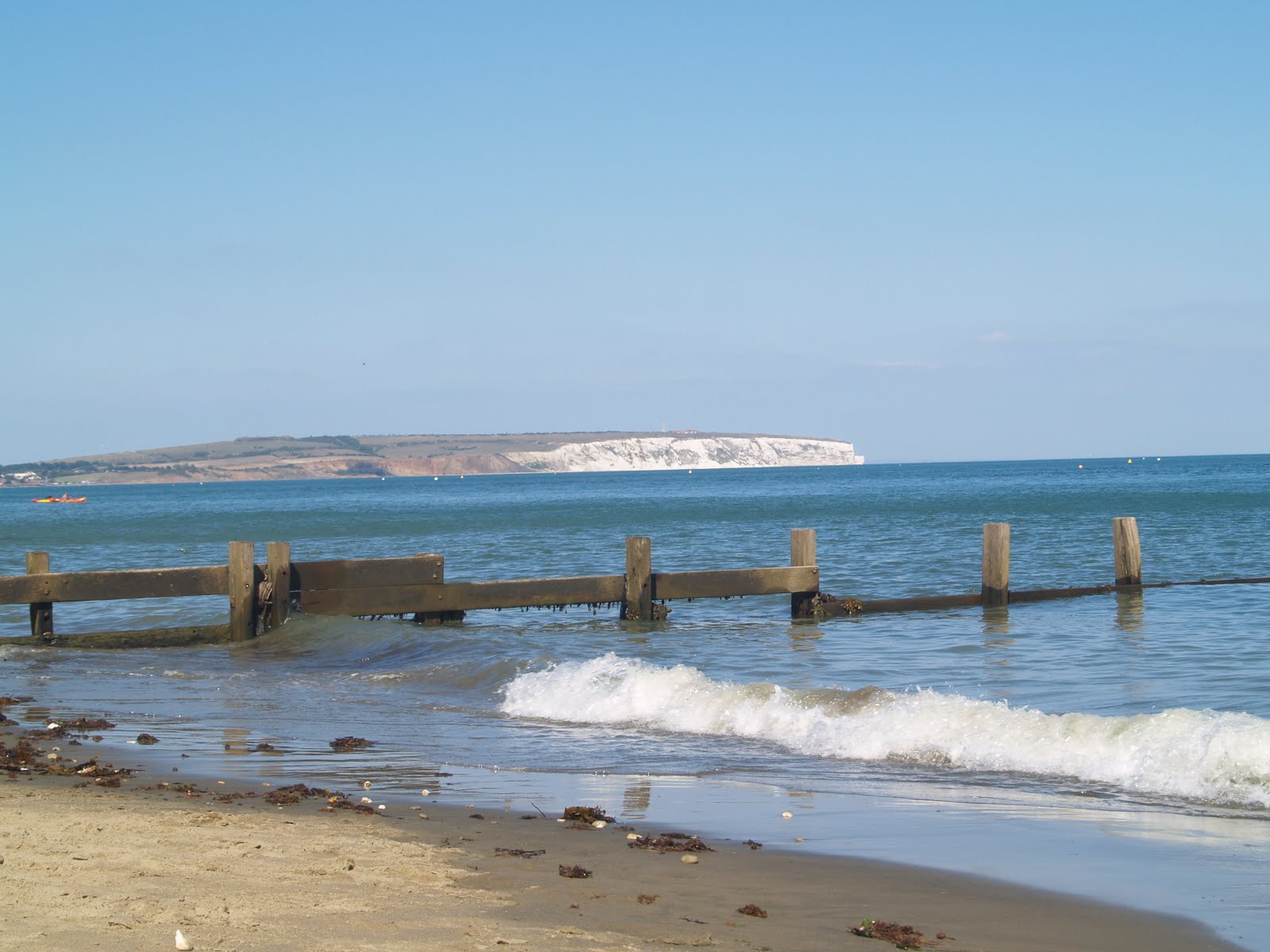
We’re just back from a week’s holiday at Shanklin on the Isle of Wight. Very nice it was too and I think we were probably pretty lucky with the weather. There was certainly some sun and we enjoyed being out and about.
I took a variety of radio gear; FT817 and HF/VHF antennas, IC-E92ED, Wouxun 70MHz and DVAP Dongle. In the end, I really only used the IC-E92ED handheld. Our apartment was located high above Shanklin on the cliffs and I discovered that I could hear all sorts of things on VHF and UHF.
On 19th and 20th August, there was a nice temperature inversion across the English Channel. I heard and worked a number of French and Belgian repeaters across the water, just using the rubber duck antenna on the IC-E92.
Still no QSOs on the Wouxun 70MHz, but having read the review in the latest Practical Wireless, I think the helical antenna is worse than I expected. It may be time to get one of the Garex Flexwhips and see how that improves performance!
Echolink made it possible to connect to my local repeater, GB3TD, using the IC-E92 to access GB3BR in Brighton (a huge signal over a fairly long sea path) and connecting the two repeaters together. Echolink using the iPhone was less successful, owing to a slow GPRS data connection.
Enjoyable mix of radio – all very simple, but plenty of interest all the same.

An iPhone4, iBCNU and APRS
I picked up an iPhone4 when I got back from Madrid. I’ve been pleased with it. The much mentioned ‘antenna issue’ can be reproduced easily, but a case solves it easily and it doesn’t cause me any issues in day to day operation.
If you’ve been reading this blog for a while, you’ll have seen me mention iBCNU an APRS client for the iPhone. I hadn’t really tried it on the iPhone4 before today, other than swapping some quick messages at home.
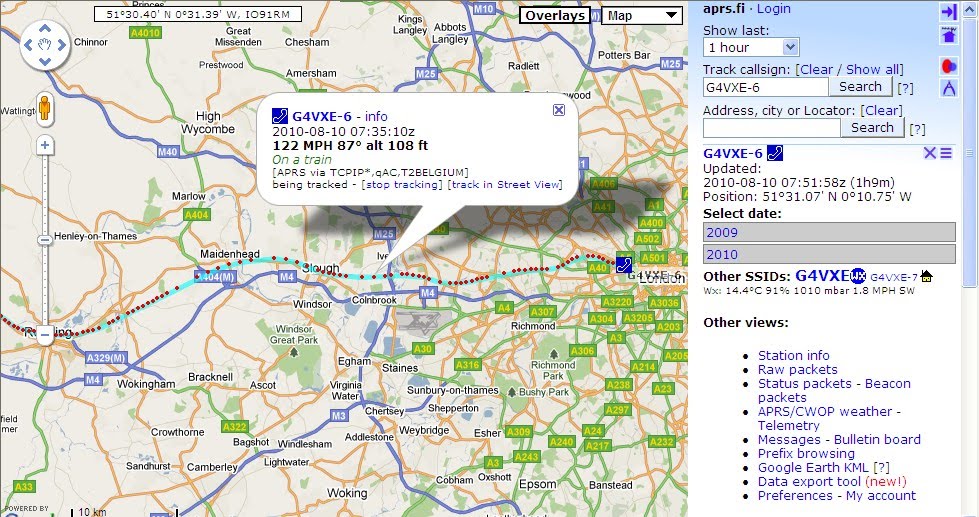
The GPS in the iPhone4 seems to lock up on a position much quicker and I found that in conjunction with iBCNU it worked really well from the train in tracking my position and displaying the speed. Top speed on the way in this morning was 125MPH (200KPH), just to the east of Slough. You can see the track on http://aprs.fi – just search for G4VXE-6 – or I did a screengrab a bit earlier.

The Perseids meteor shower and Meteorwatch
Radio amateurs have long enjoyed the Perseids meteor shower as being a good one for making VHF Meteor Scatter (MS) contacts. Back in the 1980s, I was part of the Square Bashers Dxpedition group which made many MS QSOs on 144MHz from ‘rare’ locator squares. My first MS expedition was GB2XJ from the Lizard in Cornwall (IN89 these days).
Primarily, we used high speed CW, around 600-800 lpm (120-160wpm) generated by memory keyers and tape recorders to slow the morse down. By todays standards this probably seems agricultural and it worked well. We made contacts over 2000 kms.
These days, meteor scatter contacts on VHF very often use the WSJT software which is very effective. But you don’t need specialised equipment to make QSOs. At the peak of the shower, you will easily be able to make contacts on SSB – as reflections are quite long. Listen to 144.300, 50.150 or 70.200 and see what you hear.
The shower should peak on the 12th August, but you should be able to hear decent reflections for a day or two before the peak.
On Twitter, there’s been a great deal of interest generated in the whole subject of observing meteors. People all over the would are being encouraged to ‘tweet’ when they see a meteor and use the #meteorwatch hashtag. Adrian West (@virtualastro) has put together a brilliant website devoted to Meteorwarch which will run from Wednesday 11th August to Saturday 14th August. There’s a page devoted to detecting meteors by radio which provides plenty of information to get started.
Whether your a radio observer or a visual observer – enjoy the Perseids!

Where DID you get that DVAP
Someone – ‘G7 in Northampton’ – just posted a comment to an old post asking where I got my DVAP. I can’t see where your comment has gone! Anyway…
I got my DVAP through HRO in Atlanta in the US. However, they are now available in the UK and I have heard that Waters and Stanton, Martin Lynch and RadioWorld have all had stocks – quite likely other stockists too.
Hope that helps…

Meeting up with Dave, G4BUO
It was great to meet with Dave, G4BUO last night. Though we have pretty regular QSOs in various contests, it was ages since we had met up for a beer and a chat, and very enjoyable it was.
Dave had been part of the UK team, with Andy, G4PIQ who’d achieved a brilliant 9th place in the recent World Radiosport Team Championship (WRTC) held in Moscow. It was interesting to hear how they’d achieved such a high QSO total in the contest, by using two radios on one aerial, with some fancy switchgear, allowing them to ‘interleave’ QSOs, ie one person transmitting whilst the other one was listening. Clever stuff.
As always, propagation varies from the different part of the world and the Great Circle paths took a bit of getting used to; UK is west, France and Germany is southwest and so on.
Temperature at their field day site was extremely hot, rising to around 38C at time, but the winds got high as well, with the tent almost blowing overnight; it being held down by the support team and referee whilst Dave and Andy kept on operating.

New world record on 10GHz: 2696km
According to the ‘Hyperatlantica’ website a new world record has been set for a terrestrial contact on 10GHz.
On the 10th July, the team made a 10GHz QSO between the Cape Verde islands and Southern Portugal.
Take a look around the website – it’s not extensive, so if you understand a little French, you’ll be fine. If not, then Google Translate (http://translate.google.com) is your friend.
Well done Team Hyperatlantica!














