Author Archive
 MMVARI – a skimmer for RTTY
 September 7th, 2011 |
  Author:
 I enjoyed a drink and a meal with Justin, G4TSH on Monday evening. One of the things we talked about was some software called MMVARI. This software to decode RTTY has the ability to decode a number of streams. Ideal if you’re running a pileup from a DXpedition. Or, for those of us at home, to have a display of RTTY activity across a portion of the band.
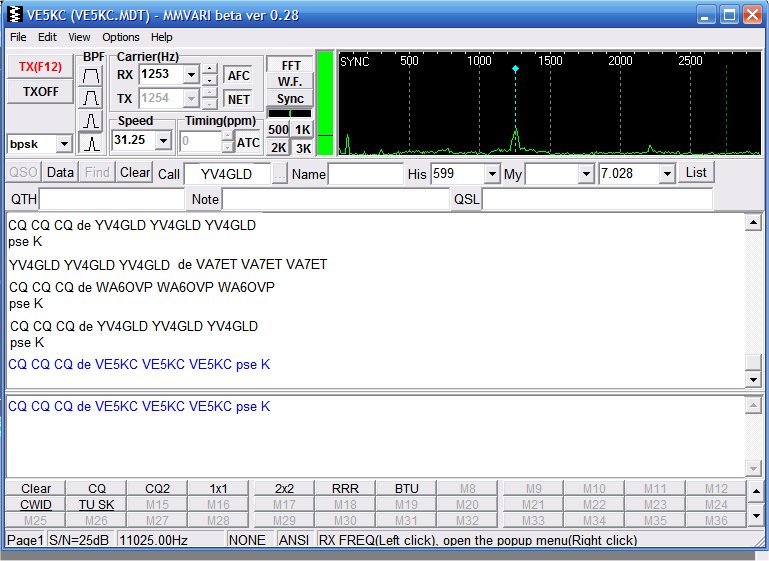
You can see it in action from CE0Y/I2DMI in this video
From some quick googling around it looks like the software can be integrated into the N1MM contest logging software for RTTY contesting. I know one DXpedition group who are planning to use it too…
Haven’t downloaded this and tried it out myself, but it definitely looks of interest.

More on JT65A and why there there’s more to Ham Radio than Morse Code
Despite the fact that I haven’t managed to make JT65-HF work on my laptop yet, the more I read about the JT65 modes and how people are working great DX with them, the more I’m impressed.
When PSK31 came out, it slipped into the ‘almost mainstream’ as a mode for people to work DX when they didn’t have a big station for CW/SSB (wonder if we’ll get to call them legacy modes one of these days…). PSK31 has built a great following over 10 or 12 years. I see JT65A for HF following in these footsteps.
Oh yes! Talking of legacy modes… someone who I greatly admire for a number of reasons recently posted on his Facebook status,’without CW it’s just CB’.
Maybe it was a bit tongue-in-cheek – but I did laugh! What a 1980s view of the world! Sure Morse code is fun and it’ll get through in many challenging conditions. I enjoy it myself and try to use it as well as I can. It’s hardly the centre of the hobby or even advancement of the hobby, is it? To even suggest that without morse code that ham radio is just a ‘appliance service’ is pretty demeaning to people who have broader interests! And I think it’s pretty demeaning to people who enjoy CB too 😉
Anyway – have a look at these great articles from W6DTW and NW7US about JT65 – how it works and how you can use it in operation.
See the articles from David and Tomas here

Low power portable on HF
If you’ve been reading this blog recently, you may have got the impression that I’ve rather lost interest in HF operation. That’s not entirely true. But I do think that DXing in general has lost its appeal on HF for me. There’s the antisocial behaviour which dogs a lot of DX operations these days. And also, once you’ve played with WSPR and JT65 on HF, there’s the nagging doubt that using CW or SSB at 100w or more is somewhat akin to fishing by lobbing a hand grenade into the water and seeing what floats to the surface. Of course, that’s completely unfair, but it’s a fun analogy! Nevertheless, it’s clear that efficiency of an ‘average’ HF DX contact is suboptimal compared to a few mW and a ‘decent’ mode.
All that having been said, I still love being able to connect up a simple HF transceiver such as my FT817 and a simple antenna like my MP1 vertical and make CW contacts over hundreds or thousands of miles. It’s particularly satisfying to do that from a portable location.
And so it was yesterday that I thoroughly enjoyed some 17 and 20m CW QSOs around Europe. It was good, too, to hear Mongolia coming in loud and clear on 30m. But I wasn’t remotely tempted to get involved with the pileup!

Adventures in programming the Anytone AT5555
As the Anytone 10m rig arrived, the different band segments were fine, but I thought it might be fun to reprogram it a little. One thing I was keen to do was to be able to listen (only listen, mind you) lower down on 27MHz ssb. I guessed that activity would be higher there than on 28MHz and that it might provide some useful propagation indicators.
I ordered the programming disk and lead which arrived quickly. However, I had an enormous amount of frustration getting the lead to install on my PC (and actually I tried pretty much every PC in the house). Sometimes the PC would detect it as a COM port and sometimes it wouldn’t. I thought it must be me doing something wrong. However in the end, I talked with Paul in the sales/service department at Nevada and we agreed that I would send it back. I completely expected him to say that it worked fine for him, but happily he declared it a faulty lead. Unfortunately, though they were out of stock so I had to wait for a replacement.
The replacement duly arrived last week and the PC immediately picked up the COM port. I still had to fiddle and faff somewhat as I didn’t realise that my Anytone had v4 software in it rather than v3. Once I ot that sorted out, I was able to retask one of the band segments so that I could listen around 27.555. This works well (on receive!).
And as I hoped, it has already shown that the band is open more often than activity on 28MHz would have us believe. Sadly, I have already heard music and mildly abusive language on there! Not much difference, in case anyone’s feeling smug, to your average DX pileup on the amateur bands.
Positively though, the Anytone has been a real favourite through the summer, listening for Es on 28MHz. With the reprogrammed segment, I’m certain that it will be a great indication of when to put a CQ out on 10m.

Just as I thought the 70MHz Es season was over
I was only saying to Andy G6REG this evening that I seemed to have missed all the 70MHz Es openings this year. After supper I popped up to the shack to listen on 28MHz and noticed a tweet from Gav M1BXF to say that 50 and 70MHz were open to Scandinavia. I was pleased to work several stations and new squares. After I’d got the ones in the log, I put the iPhone video camera on to record OH1LEU working one of my locals, G8CUL.
Remember, this is a little 70MHz station – the antenna is just a vertical

VHF simplex QSOs
When I’m out and about mobile, I generally have at least one VFO scanning about 40 channels on 2m and 70cm. The 2m FM calling frequency (145.500) is one. But generally, I seem to end up making QSOs via the repeaters. This works well and I have lots of fun and interesting contacts.
This weekend I decided to leave one of the VFOs on 145.500 and make lots of CQ calls! It yielded a couple of decent contacts. Yesterday, from one of the lanes around the village, I worked a SOTA station M0TUB/P on the summit of Cleeve Hill near Cheltenham. And today, when I was driving back from Mum’s near Cheltenham, I had an excellent QSO with Giles G0NXA across the town and up and over the Cotswold escarpment. I wonder if a few CQs on 145.500 on the daily commute will bear any fruit?

Reflections on the Es season so far
The VHF Es season seemed to kick off early this year in mid April. So here we are at the end of July and it seems to have been going for a while. Sadly, it generally starts to tail off a bit now – normally.
The new V2000 aerial has proved a great success for single hop Es on 50MHz and I have two to three hundred QSOs in the log. 70MHz has been more sparse. I think I have probably spent too much time on 50MHz at the expense of 70MHz. And for me, 144MHZ has been a wipeout, with nothing heard or worked. But that’s just a case of not being there at the right time.
The Anytone AT-5555 has proved a lot of fun on 28MHz with a good number of low power QSOs around Europe on Es. With the exception of very low power WSPR operation, this has been my most rewarding HF operation in a couple of years!














