Author Archive
 SMA Failure
 July 2nd, 2010 |
  Author:
 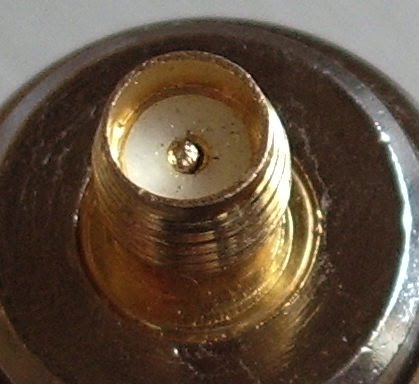 I’d heard about the famous fragility of the SMA connectors used on modern hand-helds but today I got bitten by it. I was using my RigExpert antenna analyzer to check the resonance of the stock antenna supplied with the VX-8GR (which I found to be rather broad) and thought I would check the antenna supplied with the Kenwood TH-F7E for comparison. That was sharper, but the SWR was high – the best match was at 160MHz. As I was unscrewing the antenna from the SMA to BNC adapter I heard a snap. When the antenna came off I saw that the centre pin was still in the socket of the adapter. Damn!
These SMA sockets are not meant for constant swapping of antennas. The centre pin is thin and fragile, and to make things worse the pin rotates with the antenna as you screw or unscrew it, subjecting it to a twisting action that must eventually cause metal failure. All it takes is for the female to be a bit tight, if you’ll pardon the expression, and the result could be castration of the antenna.
So I’ve had it with SMA connectors. I bought two BNC to SMA adapters several months ago and the only reason I was still using the SMA antennas is that I don’t have any short BNC antennas suitable for using with the radio on my belt. But now one of those adapters will go on the VX-8GR permanently.
What’s most upsetting about this is that I’ve spoilt my TH-F7E which I was planning to sell, as the original antenna is now useless. So now I’ll have to buy a new Kenwood antenna before I can sell the radio (£24 from W&S, eek!)

Is APRS Broken?
As I wrote yesterday, I have been experimenting with APRS on the HF bands (30 metres.) This morning I spotted a couple of mobile stations beaconing position reports, or more likely I was receiving the digipeated copies of them. I can see that position reporting on HF could be useful if you want to be tracked and are out of range of any VHF digipeaters or gateways, but HF stations with their much larger capture area and four times slower data rate really couldn’t sustain many fast-moving mobiles sending position updates every minute or so.
APRS is meant to be more than just a system for capturing position reports using radio and I find the facility to exchange messages with ham friends and know that they received them (even if they aren’t immediately able to respond) to be very useful. It isn’t a substitute for conventional digital contacts, it’s an additional way of communicating. However, unlike on VHF where you probably know the people whose calls you see on your screen, on HF there is no way of knowing whether someone wants to chat, or even if a particular station is attended. Unless the intention is to chat direct by radio, using HF seems to me to be an inefficient way of reaching the APRS-IS internet backbone. So apart from giving someone in the middle of nowhere an extra chance that their packets will be received – which would be a rather boring use of an expensive HF radio – I’m still unsure of the value to me personally of running an HF APRS station. The technology is interesting but the practical use eludes me.
Despite this I was still keen to try APRS over HF. As I didn’t know whom to contact I decided to send a greeting to Lynn, KJ4ERJ, currently holidaying in Spain, who I knew (from checking aprs.fi) was online at that moment. I disconnected my APRSIS32 client from the internet so I would know that if my message was received, it would have been picked up on the radio.
The message went out on 30m, and was repeated several times as no acknowledgements were received by my station. In the meantime I decided to send a second greeting message to Colin, 2E0XSD. No acks were received for that message either. Eventually I checked aprs.fi and sure enough my messages had made it to APRS-IS through various gateways in Switzerland and France. They had even made it to their destinations and Lynn and Colin had both sent replies. But I never received their replies over the radio, either.
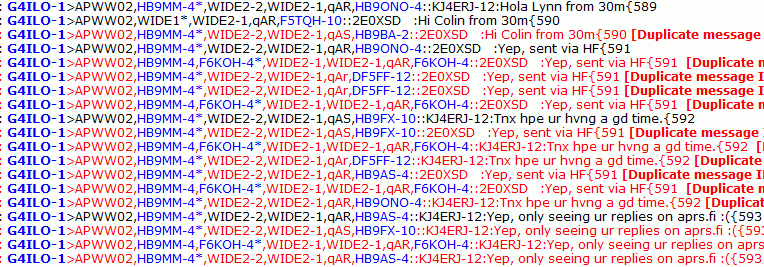 The screengrab shows a section of the raw messages list from aprs.fi which includes the paths of my messages as they were received on the internet. It appears that nearly all were received and digipeated by HB9MM-4. I’m not sure if that station also gated my messages to the internet.
The way I understand APRS to work, any messages sent to me (and any acknowledgements of messages sent by me) should be relayed back to me over RF by any stations that have heard me on RF. The acknowledgements and replies from Lynn and Colin were on APRS-IS and could be received by the HF stations that were hearing me. But they were not transmitted. I was receiving a strong signal from HB9MM-4 so it is very unlikely that the packets were sent and none of them were decoded.
What’s the use of a system for messaging if it can’t be relied on to work as intended? It seems to me that APRS is broken and is really only useful for collecting position reports where the traffic is all one way – to the internet.

APRS on HF
A post about the French ban on D-Star on QRZ.com has predictably become a platform for everyone who dislikes D-Star to reiterate their views on why it should be banned altogether, not just in France. These reasons boil down either to its use of a proprietary codec or the fact that it involves linking radios using the internet.
 I admit to toying with the idea of making a post on the lines of “what if internet linking of radios was banned worldwide? Wouldn’t that be a real catalyst for innovation, to try to replicate internet facilities using entirely amateur radio RF based methods.?” But further thought as to what would be the effect on APRS if it were denied the use of the APRS-IS internet backbone made me realize that the effect would be catastrophic. The amount of traffic would be far too great to be carried over any HF network, while the number of hops needed using a VHF network to achieve worldwide coverage would also be far too many and far too slow. You might be able to do something using a sophisticated network of amateur satellites, but that would be far too expensive. While some uses of the internet do devalue the use of radio itself, in my opinion, many of them make possible things that could not otherwise be achieved. The internet is an integral part of APRS just as it is probably an integral part of whatever D-Star is meant to achieve.
Which led me to the question of what exactly is the point of APRS over HF radio? I understand the purpose of the VHF APRS infrastructure, which is to capture the messages from local APRS stations and pass them to APRS-IS. But given that it would be impractical for messages from one side of the world to be conveyed reliably to the other using RF, what is the point of APRS networks on HF?
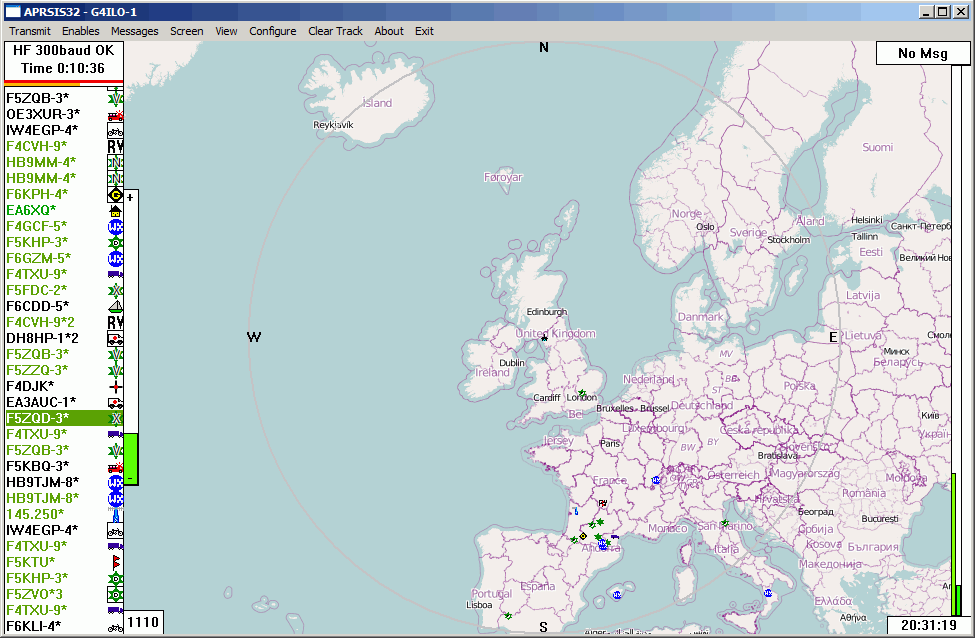
I started off the day trying the latest version of Cross Country Wireless’s APRS Messenger software. This is an interesting product in itself, in that it enables APRS traffic to use various PSK data modes, which are arguably more reliable on HF than the 300baud packet most people use. Unfortunately there are not many users. I switched to using 300baud packet and my screen quickly filled up with callsigns from all over Europe. But when I looked at aprs.fi to see its map of stations received by my station I saw only one.
The reason, I surmised (since I am far from being an expert on this) is that my client software, APRSIS32, is doing “the right thing” and not forwarding most of the messages I received as they had already propagated by the maximum number of hops. The one station whose messages I did pass on, F6KPH-4, had against it the note “Seriously bad path.” Following this was the explanation: “This station is transmitting packets with a configured path of over 3 digipeaters. This causes serious congestion in the APRS network and errors when plotting the station’s route on a map. Please consider using a path of WIDE1-1,WIDE2-1 or WIDE2-2, or even WIDE1-1,WIDE2-2 if you are moving very far away from an iGATE.”
I don’t really understand this WIDEx-x business, I just do what I am told. But I think I get the gist, which is that APRS messages sent over HF should be configured to take no more than three hops. If they don’t reach a gateway by then, they will be lost, which is just tough luck, because the HF channels can’t handle the congestion that would be caused by messages being rebroadcast more than three times.
Which brings me back to the question of what exactly is the point of APRS over HF for the average amateur? It is certainly interesting to see what you can hear using your own equipment. But if it is impractical for an RF based network to ensure that a message could get from Sydney, Australia to New York, New York without touching the internet, what useful purpose is achieved by transmitting and receiving APRS on the HF bands?

French get extra 40m allocation
Today French radio amateurs have finally been granted permission to operate in the region 7.1 to 7.2MHz. Vive la France!

GPS Interference
A week ago I received a Yaesu VX-8GR VHF/UHF APRS hand held transceiver with GPS. The transceiver performs as expected except in one extremely annoying respect – its GPS takes a very long time to get an initial fix on its position after switching on the radio. It cannot get a fix from inside the shack at all. By contrast, my HTC smartphone will get a fix in a couple of minutes whilst sitting in its charger cradle on the shack desk. Or at least, it did.
This morning I noticed on aprs.fi that the last reported position of my smartphone, G4ILO-10, was somewhere in Somerset. I started the APRSISCE application with the intent of “bringing it back home” by sending a position report with the correct location. But after ten minutes the phone had not managed to get a fix.
I switched off all my radio equipment in case one of them was an interference source, and rebooted the phone, and eventually after several more minutes it obtained an accurate fix. I am beginning to suspect that something is interfering with GPS reception in the area of my house.
If you Google “GPS interference” you will find links to numerous articles and research papers raising concerns about what is apparently an increasingly common problem. One article states that a directional television receiving antenna widely available in the consumer market contains an amplifier which can emit spurious radiation in the GPS L1 frequency band with sufficient power to interfere with GPS reception at distances of 200 meters or more. Other potential interference sources include spurious outputs from TV transmitters.
Another website states that “We are seeing increasing evidence of GPS interference and also apparent erratic behaviour (e.g. mis-reported location)” and provides a form for reporting cases of interference. This page provides links to two reports on the issue which unfortunately require registration in order to access them.
Have other amateur GPS users experienced difficulty in receiving the satellites or an increase in inaccurate position reports? For many GPS applications the effects of this could have rather greater impact than a radio ham’s inability to report his position to aprs.fi. Perhaps the US administration was rather hasty in its decision to decommission Loran.

D-Star illegal in France
 Steve, GW7AAV, was quick off the mark to post about the announcement yesterday on the website of DR@F, the French association of amateur digital mode operators, that D-Star has been ruled illegal in France. The reasons for the ruling, if I understand correctly, are that D-Star permits a radio to be connected to the internet (which is apparently illegal in France) and that it breaches rules prohibiting encrypted communications on grounds of national security because parts of the patented proprietary AMBE codec are undisclosed.
The group is appealing for all European amateurs to sign a petition to the European Parliament against the ban. No doubt this will have as much of an effect as the two petitions to the British Parliament to get interference-causing internet-over-mains-wiring devices banned. Issues like this illustrate what a hopeless idea the European Union really is as it attempts to harmonize things between member states while countries (especially France, which started the EU but implemented only the directives that suited it) stick tenaciously to their own different rules and regulations when they want to.
I’m not sure if it is true that French amateurs are not permitted to connect radios to the internet, as if it were, Echolink nodes and APRS gateways would also not be permitted, and a quick check of some relevant websites show several of each with F callsigns currently operating. As for the argument that transmissions are encrypted, whilst the closed and proprietary nature of the codec does prevent someone from designing their own decoder, the chips (and indeed D-Star radios) are readily obtainable allowing anyone who wishes to do so to monitor communications.
I am not, as regular readers know, a fan of D-Star, but this looks to me a bit like the result someone who is also anti D-Star trying to abuse their position to get it made illegal in France. I hope our French comrades are successful in getting this ban lifted.

BBC to investigate interference complaints
Ofcom, the UK telecommunications regulatory authority, has announced that it will pass the responsibility for investigating reports of interference to TV and radio services to the BBC from July 1st. On that date, members of the public experiencing interference to radio or TV should lodge a complaint with the BBC using a web form, which may advise them of issues such as a local transmitter fault.
Some UK amateurs have expressed concern about the possible effect of this change, but I don’t consider it likely to make much difference. As far as I can see, Ofcom will still be responsible for issues of interference to amateur radio such as that caused by PLT devices. These days, TVI and BCI are fairly infrequently experienced and almost always caused by a poor or faulty antenna installation or receiving equipment. Putting the BBC in charge of investigating complaints of interference to its own services makes a lot of sense.














