Author Archive
 Stealth Antennas
 October 1st, 2010 |
  Author:
  Today sees the publication of a new RSGB book by Steve Nichols, “Stealth Antennas.” I haven’t seen the book myself, but I was asked by Steve to contribute a description of my own stealth antenna farm as one of the practical examples. It remains to be seen whether this entitles me to receive a free copy. 😉 It isn’t even in the RSGB Bookshop yet, but hopefully it soon will be.
I think this is an important book which addresses an issue that I believe many new radio amateurs (and many not so new, such as myself) find themselves faced with, that of what to do when circumstances prevent the erection of the kind of antennas so many experts say you need. I hope the book helps to dispel the impression created by many that in order to enjoy the hobby one needs a beam mounted on a huge tower, or at least a full size dipole up high and in the clear. It would be nice if you could have one of these, but it certainly isn’t the end of the world if you can’t.

Advice to amateur programmers
If you know a bit about programming and have been thinking of writing a ham radio application, here’s a word of advice. Don’t. If you do, it will take over your hobby, your spare time will never be the same again and you’ll be lucky to receive much thanks for it.
First, you’ll have to spend countless hours answering emails that ask the same basic questions. You’ll have to do this no matter how much time you put into writing documentation or creating an FAQ or a wiki, because no-one will read it. And believe me, starting the day with an inbox full of the same old questions gets tiresome very quickly.
Second, you’ll be expected to know why your program won’t run on a user’s computer, without being given any idea what kind of computer it is or what version of operating system it uses. If the user has done anything that might affect your program’s ability to run, you won’t be told that either. And beware if you should choose not to spend too much time looking into someone’s obscure problem. One user of VOAProp who had a problem several years ago that I was unwilling to solve threatened to write to the RSGB accusing me of lacking in ham spirit. That bruising encounter is one reason I gave up developing programs for the hobby completely and now make it as clear as I possibly can that the programs I wrote continue to be available on the sole condition that I provide absolutely no support for them whatsoever.
Third, you’ll receive a lot of requests from armchair programmers for changes and improvements. Some of these might be good ideas, though you still may not want to implement them. But many will be things that only that person thinks is a good idea, quite possibly because they haven’t read the instructions or understood how the program is supposed to be used. These requests will contain no acknowledgement of the amount of time you will have to spend making these suggestions happen. You’ll have the job of justifying why you shouldn’t spend several hours or days coding some function that you personally have no interest in using. And some people find it hard to take “no” for an answer. If you wanted to write programs to someone else’s spec you’d get a job as a programmer, wouldn’t you? Then at least you’d be paid for it.
Last, but by no means least, you’ll get complaints about bugs. Yes, complaints, even if your program is free. Often, these emails will be the first contact you ever have with that particular user. But don’t expect them to start with any pleasantries. If you are particularly unlucky, as I was with one email I received from someone who couldn’t get KComm to run, you’ll be blamed for wasting their time. Sometimes the “bugs” will be due to user error or failing to read the instructions, but it’s rare that you’ll receive an apology after pointing that out. And believe me, those who complain most bitterly won’t get the joke if you offer to refund what they paid for the software.
Fortunately there are users who will make you feel that your effort is worthwhile. You might even be lucky and build a team of online friends who test your program and give you useful feedback about it. But it doesn’t take many of the other sort of comments to make you wonder why you bother. If you develop your program solely for your own use you will save yourself a lot of trouble.
It’s a good job no-one takes my advice because if ham programmers didn’t release their programs for free and put up with all the brickbats I’ve described the hobby would be a lot poorer for it. But if you’ve ever seen a program mentioned in some old forum posting and been unable to find a copy of it, now you know why.
So next time you use a bit of free ham radio software ask yourself: Did I remember to say thank you for it? Before bothering the developer with a question, take the time to read the documentation and search any relevant forum for the answer. And if you think you found a bug or have a suggestion for an improvement, try not to make it sound like a criticism or a demand. A little tact goes a long way.

40m bandplan confusion
Peter, G4NKX, uncovered a can of worms the other day after encountering some unpleasantness by CW users in what has traditionally been the PSK segment of 40m starting at 7.035MHz. It appears that the 40m band plan in IARU Region 1 (Europe) has been changed, but nobody has been told, including the IARU.org website which still has copies of the old band plan coming up top in Google searches for “IARU Region 1 Bandplan“.
Under the current European band plan for 40m, CW now has free reign up to 7.040MHz, with narrow band digimodes from 7.040 to 7.050. So the start of PSK31 operation is now presumably 7.040MHz. However the bright sparks who sit in their ivory towers and decide this sort of thing clearly forgot about the real world in which people don’t find out about something unless it is shoved under their noses. People will operate where they hear other people operating, which creates a very powerful inertia against any form of change. These band plan changes came into effect on 29th March 2009, yet people are still in ignorance of them 18 months later. Where was the letter from the national society to each licensed amateur, informing them of the changes?
But more to the point, why change? It’s just a recipe for chaos and an opportunity for the band police to cause unpleasantness, just for the sake of an extra 5KHz for CW operators. It also now means that digital mode users in Europe must use a different part of the spectrum to those in the USA, making transatlantic digital DX impossible without incurring the wrath of the policemen. Frankly, I don’t blame PSK31 users for staying where they were and refusing to be shunted around by bandplan changes that don’t give them any benefits.
I’m somewhat confused about what the 40m USA bandplan is. The document on the IARU website for Region 2 shows narrow band digital modes starting at 7.035MHz. But I thought people in the USA operated PSK31 starting at 7.070MHz and other narrow band modes like JT65A at 7.075MHz? No wonder I have never heard any Stateside DX on digital.
Radio waves don’t stop at IARU regional boundaries so what is the point in having bandplans that put digital modes in different parts of the band in different regions? It just goes to prove that the powers that be who make these decisions think the only modes that matter are SSB and CW.

Too many distractions
 |
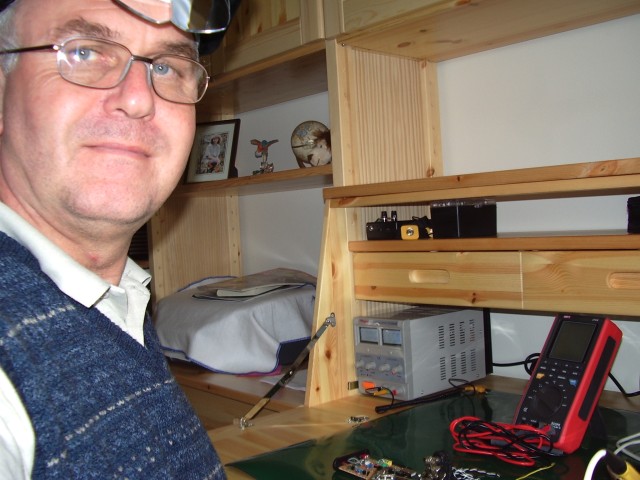
| My bureau-workshop |
I have sometimes seen comments to this blog that are disparaging towards the idea of stealth operation. I don’t for a moment accept that stealth antennas are worse than the modest wire antennas many hams in the UK who don’t have deep pockets, large gardens and amazingly tolerant neighbours use. RF doesn’t care whether an antenna is visible or not, it’s what you do to make the antenna invisible that might compromise performance and with the small gardens without trees that so many of us in the UK have, most of us have to live with compromise.
But the real test of a ham radio station is whether it allows you to pursue enough activities to maintain interest in the hobby. And based on that criterion I think G4ILO does very well. One of the best additions to the shack was to make a dedicated work area for construction in a bureau unit whose door drops down to make a work surface and which can be closed when I have done enough without having to put everything away. I have a greater interest in building stuff now that I have somewhere to do it.
In fact there are more things I would like to do, radio-wise, than I have time to do. Last weekend, for example, I would like to have tried making some contacts in the worldwide RTTY contest but of all the radio things I did that weekend, giving away some contest points was something I didn’t get around to.
Today I was trying to finish up my homebrew SignaLink USB clone, but I made the mistake of turning the K3 on and leaving JT65-HF running and I kept on being distracted by seeing CQ calls from DX stations. In between work on the interface I made contacts with YV6BFE, N8ABY, AA1CZ and KD0AGX plus a couple of Europeans, all using 25W to the attic dipole. My signals were spotted in Japan and far eastern Russia, though I didn’t hear anyone that far east. DU1GM, whom I worked a few days ago, was calling for most of the afternoon with no takers.
The SignaLink USB clone is just about finished and does work. After I made up an interface cable between it and the FT-817ND I made one solid PSK31 contact with F5TTI on 30m with it on the test bench. So now it just has to be put into its case and it will be completed.

Indian tracker
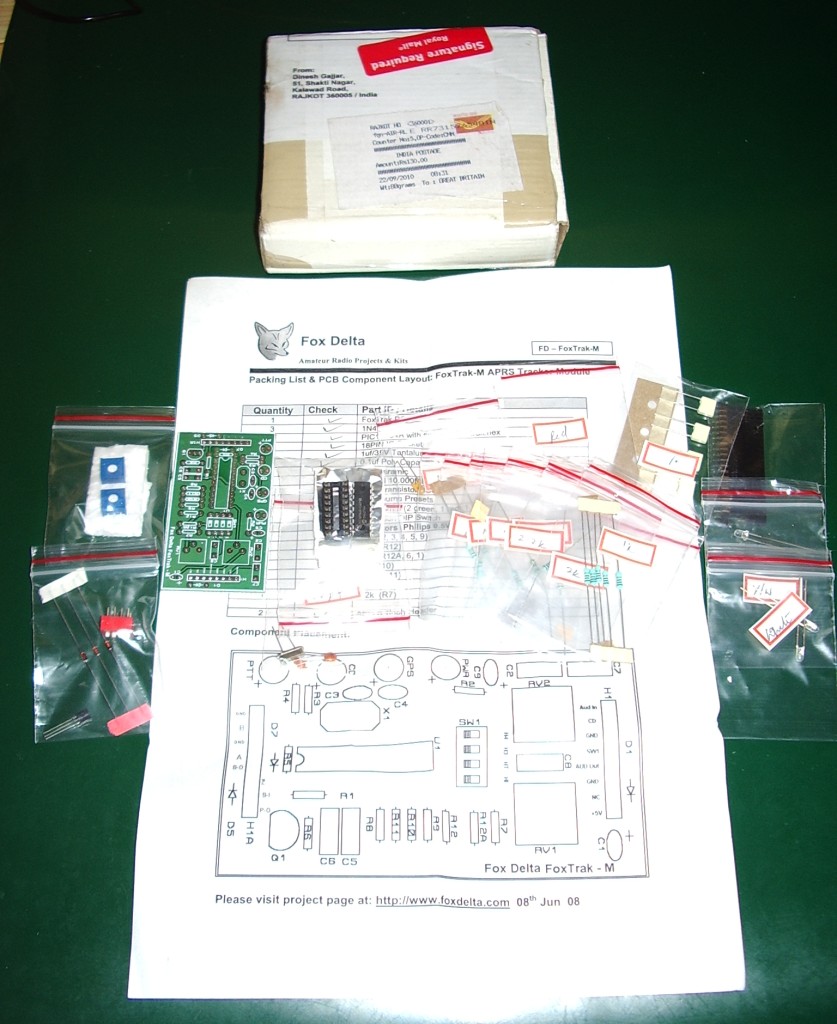
This morning a small package arrived from India. It is a FoxTrak-M APRS Tracker Module kit from Fox Delta.
Fox Delta has an interesting range of kits for anyone interested in APRS, packet radio, digital modes or EchoLink. They are all extremely good value – the website suggests that they are sold on a non-profit basis. A couple of weeks ago I asked about one of these kits in a forum somewhere and an American ham complained that the parts were of poor quality, the instructions were poor and it took a long time to come from India. I think that is just the biased nonsense one sometimes hears from US hams about anything from India or China. The PCB is screen printed and looks fine, all the components are standard components and have been packed into individual small polythene bags for each value, and it took a week to arrive which is a lot faster than anything coming from the US via the postal service. It’s true you don’t get Elecraft style step by step building instructions, but it really isn’t rocket science to work out which part goes where on the circuit board.
Hopefully this module will form a stand-alone GPS tracker that I can use with my other VHF radios. However, before I get started on it I have to finish my DIY SignaLink USB project.

Groundhog Day
After installing the four port serial card in the shack PC which allowed me to have computer control of my Elecraft K2 I decided to borrow the USB sound card that was being used by my EchoLink hotspot and get my HF APRS gateway up and running again on transmit as well as receive. It is running very well and, although I suppose it may just be conditions, it seems to be receiving more stations than when I was using the K3. I am also surprised at how well my 10W output gets out. The experts are always saying how poor a mode FSK300 packet is, but I transmitted several test messages (into my stealth attic magnetic loop) and they were all received by other gateways.
However, something went very wrong on Sunday. Replies to a couple of messages I sent kept being received over and over again. I also kept receiving the same messages over and over again from a couple of stations. It was like the film Groundhog Day, except it was more like Groundhog Five Minutes. And it was very annoying as these damn messages kept generating pop-up balloons from APRSISCE’s new messaging system.
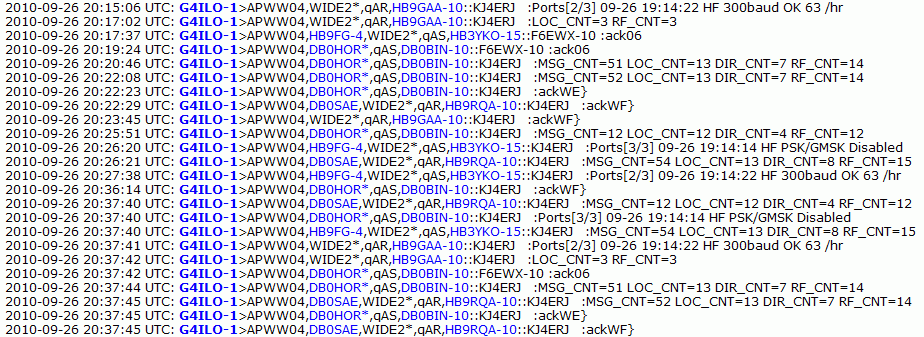
Eventually I became convinced there must be a problem with APRSISCE and I sent a bunch of logs over to Lynn, KJ4ERJ, the program’s developer. However I now think the problem is down to the configuration of some stations in Europe that are unnecessarily digipeating or gating traffic from the internet to RF and somehow managed to create an endless loop. Aprs.fi shows that some of the messages continued to circulate for more than 10 minutes after I had shut down all the computers and radios and gone downstairs in frustration. But even Lynn hasn’t manage to figure out who the culprit was.
The trouble with the APRS HF network in Europe is that there is no co-ordination at all. Anyone can connect some software or a TNC to a radio, configure it however they see fit (perhaps basing their settings on out-of-date books, obsolete web pages or nonsense thinking like “WIDE5-5 must be more than twice as good as than WIDE2-2”) and start digipeating or gating traffic regardless of whether there is a need for it. There are stations in France who are gatewaying information from VHF to HF that serves no useful purpose there. What use is it to me in the north of England to know the meeting date of a club in the south of France or the details of a repeater in the Pyrenees?
These days it is far too easy for people to get on the air without first having to properly understand what it is they are doing. And many hams seem to think it is their duty to radiate RF even if the most useful thing they could do in this particular case is simply to receive.
You can’t have a network without co-ordination of the stations that participate in it. But, no doubt in part because we all speak different languages, there is no online forum that everyone doing APRS on HF in Europe can join to discuss the issues and resolve the problems.

QRP spot
 Now that I have my K2 connected again for computer control I have found that a few things in KComm that worked with the K3 don’t work with the K2 because the control commands, though they may look the same, don’t all work the same way on both radios. So I spent yesterday evening fixing the problems.
One of the things that didn’t work was the auto-repeat option for CQ calling. I was testing it by sending a CQ on 30m with just 1W output into the magnetic loop in the attic. I didn’t expect anyone to come back to me, and no-one did, but I was surprised that my signal was spotted in Northern Spain by EA1GFY. The effectiveness of that magnetic loop antenna never fails to amaze me.
I don’t think many people use as little as 1W on PSK31 but it would be interesting to see what you could work with such low power. It seems to me that 1000 miles per watt should be perfectly achievable. I’ve made a few contacts using the K2 and 4 or 5 watts over similar distances to what I’d expect using the K3 and 40 watts. I think conditions, more than power, determine how far you can work. More power just makes it easier.