Author Archive
 Current set-up for WSPR, JT65 and JT9-1
 August 3rd, 2014 |
  Author: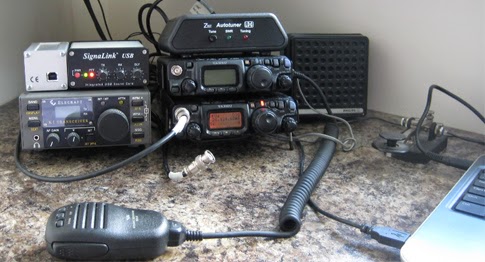
This is a photo of the kit currently used. The top FT817ND is used mainly for 2m and 70cms (local FM net, SSB and CW, beacon hunting) and the lower FT817 for WSPR, JT65 and JT9-1 mainly on 6m and 10m. The lower rig is set at 2.5W, but the cable run to the V2000 vertical is lossy on 6m. I use a SignaLink USB audio interface to the PC. This works well. For all digital modes I use the FT817 on DIG setting via the rear connector. Sometimes I use the Z817 ATU, which I find very good. With this, I can get onto 5MHz and some other bands.
Best DX (on WSPR) is Australia at 1W out on 40, 20 and 10m and Israel on 6m WSPR (1W ERP).
Not shown (on shelf above) is the 472kHz homebrew transverter, the 15m MFJ Cub and the Mizuho 200mW 2m SSB rig. Also out of sight are a 136kHz beacon, the 2m Fredbox, the 6m Sixbox, the VLF 8-9kHz beacon, and optical rigs. I am waiting for better health to be able to use these again. Currently my operating is all from home and mainly modes not requiring me to talk, although I have ventured onto our Monday night FM net and the odd 2m and 70cm contest.

Same callsigns?
One of the drawbacks of WSPR (currently) is you tend to get spotted, or spot, the same stations over and over again. I am even seeing the same stations being spotted on 10m and on 6m.
It would be very nice if there were a lot more active stations, so spots came from a variety of stations. I am even seeing this on JT65 and JT9-1.
Perhaps people think these “new fangled” digital modes are hard and so only a limited number of people (currently) use them. Let me say, if even I can use these modes then anyone can! All these modes are great with low power and have really opened my eyes as to how far very low powered signal can be detected.
 |
| 10m unique WSPR spots this afternoon (duplicates not shown) |

Overpriced KX3 options
Steve G1KQH has spotted the price of “after-market” mics on eBay. Under £5.
“The price of a Microphone:Someone is having a good laugh at stitching folk up with those KX3 Mics. The whole KX3 price is through the roof but there are plenty on the bands?”

Near miss – 11742km on 10m JT65
This evening CA3SOC (Chile) was calling CQ on 10m JT65. I called and called him – he called CQ about 14 times – but I was unable to raise him. At the start he was -16dB S/N but in the end was down to -22dB S/N. I was copied in Sweden at the same time, but that was no compensation.
Earlier in the afternoon I worked an E74 on PSK63, my first ever QSO on PSK at that speed. I am finding real-time keyboard operating in PSK modes quite “challenging”. Whenever I use the keyboard e.g to write this blog, I make lots of errors that need correcting. This is hard on PSK31 and PSK63 in real time. JT65 and JT9-1 are a lot easier. Currently I am using Digipan software which is simple and basic for PSK modes. I am using WSJTX V1.3 r3673 for JT65 and JT9-1.

KX3 antenna failure
I read on the M1KTA blog that an antenna lead on one of his Elecraft KX3 units has failed. I know these have seen some harsh portable field use but I would not have expected this. I have owned an FT817 for close on 14 years and, touch wood, it has never once failed me – still the same PA, same everything.
In my view, the KX3 is overpriced (over here in the UK) and not well built for rugged field use. I don’t doubt it has excellent features and an excellent receiver, but it is still over twice as much as an FT817ND which covers DC to blue light, out of the box ready built. The KX3 is a mess for leads, coming out all over the place. The FT817 is neat, rugged, and compact.
For me, the FT817 still wins.

Continuing JT65/JT9 today
When we get back from shopping I shall return to JT65-HF and JT9-1 modes hoping to work more stations. Yesterday, staying on 20m, I worked 4 Europeans running 2.5 or 5W. JT65-HF is very intuitive and works well. Althought I have had JT9-1 QSOs on 10m in the past, I suspect the rig stability is “challenging” and JT65-HF gives me a better chance. JT65-HF is some 4dB worse than WSPR but the TX period is only 48 secs (1 minute TX period but actual TX is less) so may be better with QSB? JT9-1 is a narrower bandwidth mode than JT65-HF and is about 2dB worse than WSPR. Of course, JT65 and JT9 are proper QSO modes.
Sunspot count today is 76 (decent) and 20-30MHz conditions are supposed to be “normal” so there could well be some F2 (as well as Es) on 10m today. JT65-HF and JT9-1 on 10m are calling I think.
The great advantage of WSPR is you can set the rig running and monitor things in another room. JT65 and JT9 seem to require “hands on” operation, which is fine.

More JT65 QSOs
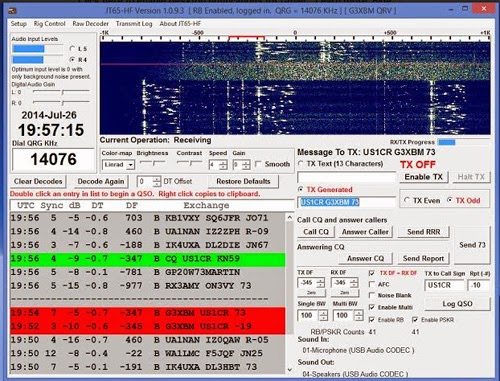
This evening I went on 20m JT65 again and managed a couple of European QSOs in reply to the CQs of others. I am using JT65-HF software that is very simple to use. So far I have used the FT817 at either 2.5 or 5W.
 |
| JT65-HF screenshot |
If you see a station calling CQ (shows up in green) you just click on it to start a QSO with that station. If he copies you and replies then the started QSO shows up in red – all very simple. Wonder if there is a similar (easy) package for JT9-1 on HF?
Looking on PSK Reporter I see plenty of USA stations were copying me too, so it should not be too hard to work DX with just a little effort even with my compromise antenna. When 10m and 6m are open, DX should be easier still.
With JT65-HF and JT9-1, I have to be in the shack, but at least there is no speaking, saving my poor voice.














