Archive for March, 2010
 ITU Declares Texas A DXCC Entity
 March 31st, 2010 |
  Author:
 The United States FCC will no longer issue amateur radio licenses to Texans; all licenses will be issued out of the Republic of Texas government office in Houston. Texan amateur radio licenses will automatically include a concealed weapons permit and VIP parking permits for Chilis restaurants.
Texas, as part of the United States secession agreement, will also assume responsibility for the portion of national debt incurred by Texans. This has been calculated at nearly $5 trillion, or roughly 39% of the current US national debt.
The new Texan TX prefix will become active April 2 at 00:00 UTC and is eligible for DXCC credit.

CQ2
Martin, G8JNJ, sent me an email with some suggestions for getting the super-regenerative Fredbox receiver to work. He also sent me a link to the blog of Steve, G4AQB, which mentions the Practical Wireless CQ2 receiver design on which the Fredbox receiver is supposed to be based. I remember the name “CQ2” and the picture on the magazine front cover and circuit diagram shown on Steve’s site look similar to the receiver I built in the early 70s to listen to the 2 metre band which finally gave me the interest to get my Class B (144MHz and up) amateur radio license. I seem to recall that the article also had detailed drawings of how the components in the receiver were to be laid out.
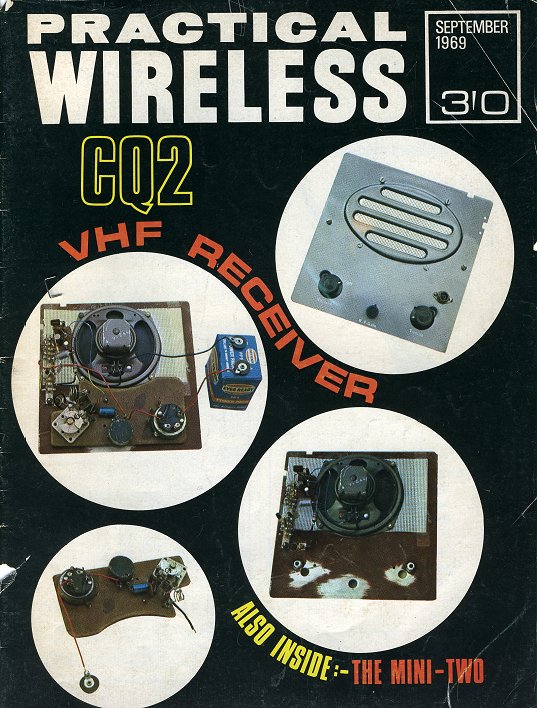 Steve writes that he mounted the receiver on an aluminium front panel but that this played havoc with the tuned circuit so he rebuilt it on a piece of plywood! My memory is pretty poor these days but my recollection is that I built it into an aluminium box of the sort that you could readily buy from the local radio parts shop (those were the days when there were local radio parts shops!), like a box with a lid secured with two self tapping screws. The box stood on its side so the lid was the front panel of the receiver.
Steve writes that he built a quad antenna to use with the receiver. My antenna was a dipole mounted on a wooden stand in my bedroom and fed with a few feet of audio co-ax, since at the time I was ignorant of coaxial cable properties like impedance or loss! In those days I lived with my parents in Rayleigh, Essex. I was able to receive the local police on the CQ2 receiver, as well as amateurs in the Southend area such as Barry G8HNX, John G8IDI and Chas G8HVS. I could receive the GB3VHF beacon from Wrotham, Kent, and also a couple of old-timers who had a regular sked: G6LL whom I think was in Hertfordshire and G5OX who may have been in Ashford, Kent (or perhaps it was the other way round.) This was nearly 40 years ago and I’m surprised I can still remember any of it!
Steve also writes that the radiation from the super-regenerative receiver wiped out the local TVs. I don’t remember that, fortunately, or an end may have been put to my aspirations to be a radio ham before they even started!
But my first proper transceiver – a Hudson AM108 ex-taxi radio that I bought for £5 at the RSGB Woburn Rally in 1973 (which was actually before I was licensed) caused patterning on my parents’ TV on receive! After I got my license I soon found that it caused serious breakthrough on my father’s stereo hi-fi on transmit as well, so my operating was done mobile /M from the car after that.
Later I built my own 4-channel 2m FM transmitter (using tubes, to another PW design) which I used in conjunction with a Microwave Modules receive converter and my short wave receiver (also home built, using tubes, from a PW design.)
So much fun with such primitive equipment! I often wonder if all the technological advances we have today have really added to the enjoyment of the hobby.

Showing M$ who’s boss
One of the things that annoys me about Microsoft is that it has created an operating system that behaves as if it is your job to service its needs rather than a tool that is supposed to serve yours.
I’m thinking specifically about updates. Windows constantly nags you to install updates (which wouldn’t be necessary if they’d designed the thing properly in the first place) and then it expects you to interrupt what you’re doing while it does. After you have downloaded updates it nags you to restart the computer in order to install them. Perhaps they could have designed it so you didn’t have to restart the entire OS after every change? When you do shut down it won’t let you switch off while it is installing updates, so you have to wait around twiddling your thumbs until it is finished.
Hey, Microsoft, it’s MY computer, okay?
I just received an update to Internet Explorer 8 (which I don’t even use) today. After it was downloaded, Windows nagged me twice to restart the system by popping up a window in front of what I was doing, even though I was in the middle of writing something and did not want these interruptions to my train of thought.
Fortunately there is a magic incantation you can remember to show Microsoft who’s boss. It’s:
net stop wuauserv
Just click Start, Run, type the magic words into the box and hit the Enter key. What it does is kill the Windows update service for the remainder of that session. Windows will nag you no longer, and your updates will be installed the next time YOU decide to restart.

3830 Claimed Scores | 2010 CQ WPX SSB | International Low Power
 International Single Operator All Band.
- P49Y (AE6Y) | 3842 Qs | 1048 Prefixes | 36hrs | 13,657,536 Points [NCCC].
- 3V8SS (KF5EYY) | 1577 Qs | 691 Prefixes | 30h29min| 4,036,822 Points [RR DX].
- PY2NY | 1622 Qs | 726 Prefixes | 32hours | 3,442,692 Points [Araucaria DX].
n = 14 scores submitted in this category.
Options there are options for low power, low profile RadioSport operators. One can operate from a DX location to satisfy the competitive spirit and Andy, P49Y entered an ionospheric score from his Aruba location. In addition, he lead the Northern California Contest Club to a banner position fulfilling the club’s motto, “Excellence In Amateur Radio Contesting.“
An accomplishment well done!
Believe in your signal.

3830 Claimed Scores | 2010 CQ WPX SSB | USA Low Power
 USA Single Operator All Band.
- KR5X (K1BX) | 1974 Qs | 868 Prefixes | 36hrs | 4,463,256 Points [YCCC].
- NV1N (N1UR) | 1761 Qs | 805 Prefixes | 36hrs | 3,761,185 Points [YCCC].
- KW3W | 574 Qs | 366 Prefixes | 18hrs | 552,294 Points [PVRC].
n = 33 scores submitted in this category.
The climatic ionospheric event of the season guaranteed ham radio fun and CQ WPX SSB delivered on the promise. Prefix multipliers added extra value even if one operated from their apartment balcony or with a long wire with counterpoise from a college room in a dormitory.
Congratulations K1BX who piloted KR5X to a 3830 Claimed Score first place finish while leading the Yankee Clipper Contest Club to its banner position for the year.
73 from the shackadelic on the beach.

The NA-034 operation that almost wasn’t, Part III
If you haven’t read Part I and Part II first, you might want to do that.
As I mentioned previously, meeting Larry, KH6ITY on the air turned out to be a great stroke of luck for me, and the contact proved to be beneficial for both of us. Larry is a technology teacher at a high school in Texas, and when he responded to my call on the air, he was looking for a contact to speak with his class via ham radio as a demonstration. I was more than happy to do so, but what Larry told me was that while he could hear me, my audio was very distorted and I was extremely difficult to understand. Somehow, I managed to convey to him enough that he understood that I’d done some pretty extensive  troubleshooting on the antenna system, so he suggested that I try to reduce the transmitter power to see if that would help. Since I’d connected the radio directly to the car battery, I figured that power wouldn’t likely be the source of the problem, but given that nothing else I’d tried had worked, I figured I’d give it a shot.
I turned the power down to about 40% of the maximum and transmitted, asking Larry if my signal was any better. Before he even answered, I knew what the answer was: I was no longer hearing that odd noise in my headset, and Larry confirmed that indeed my signal had no issues. Although the signal strength was somewhat reduced, Larry was able to report that the audio artifacts were completely gone. He then asked me about what kind of radio I was using (an Icom 706 MKIIG), and when I told him that, I think that both he and I figured out the problem, both from similar past experiences. First, a little bit of background.
All electronic equipment requires a power supply that is capable of supplying a certain amount of electrical current at a voltage within a specified range. According to the manual, the 706 MKIIG draws up to 20 amps at 13.8 volts DC+/- 15%. Although the electrical system in a car is rated at 12 volts DC, it turns out that a charged car battery will provide somewhat more than 12 volts, and the battery is charged at somewhere between 13.2 to 14.4 volts. A running engine which is charging the battery should provide enough power for the radio, but what happens if the car isn’t running? It turns out that in practice, there is some “give” in these numbers, but at some point, the radio doesn’t function properly.
For those of you who have forgotten (or never knew), one of the most basic formulas in electricity is known as Ohm’s Law. It states the relationship between voltage, current, and resistance. In order to try to keep my readers awake, I’ll skip all the details and say that Ohms law explains that the length of the power cord, among other factors, affects the amount of actual power that the car battery is able to deliver to the radio. I’d used this exact same setup previously from at least two different vehicles without any issue. However, it seems that the battery in the rental car (a Mazda 5) that I had was a bit weaker than the others that I’d previously used and it just wasn’t capable of delivering enough power to the radio.
The Icom 706 MkIIG is probably one of the most popular radios made in recent years. It is very portable, capable of transmitting on all the HF radio bands, (10m through 160m) and can also transmit on VHF (6m and 2m) and UHF bands (70 cm). This was the first HF radio that I ever bought, and it has served me very well for the almost 10 years that I’ve owned it. However, it does have one problem (perhaps common to other similar radios): When it doesn’t get enough power to transmit properly, instead of simply shutting down or refusing to transmit, the transmitted audio gets distorted.
Both Larry and I had previous experiences where the radio wasn’t supplied enough power and exhibited this problem. In my case, the very first time that I ever tried to operate from a car, I was parked outside a friend’s vacation home in upstate New York, and figured that the accessory adapter (we called them cigarette lighters back then) looked like an easy way to hook up the radio. It turns out that the wiring for the lighter plug wasn’t capable of carrying the 20amps at 13.8vdc that the radio requires to transmit at full power. My audio was distorted, and a helpful ham in Italy (I wish I’d made a note of his call) helped me to troubleshoot the problem. At the time, the solution was to simply connect the radio directly to the car battery, which did the trick.
Since I was already connected directly to the battery, the only other thing that I could do was to start the engine, hoping that the charging current provided by the car’s alternator would provide enough power to the radio when transmitting at full power. I adjusted the transmitter output back to 100%, and Larry verified that my audio was still clear. Finally, I was on the air, and could start making contacts.

The antenna was mounted on a picnic table about 15 meters away, I was sitting underneath some trees, and I was able to make contact with other stations all around the world. This was what I’d planned to do.
However, Murphy still had one surprise in store for me, which didn’t crop up until the next day.
The sage concludes with Part IV.

Handiham World for 31 March 2010
Welcome to Handiham World!
Before we do anything else, I’d like to share last week’s Midwinter Madness Hamfest with our readers. After that, we have a special edition of the Handiham World that is dedicated to operator improvement.
Midwinter Madness Hamfest Photos

Our thanks to the Robbinsdale ARC for table space at Midwinter Madness, the closest Hamfest to Handiham Headquarters! Photo credit: RARC.
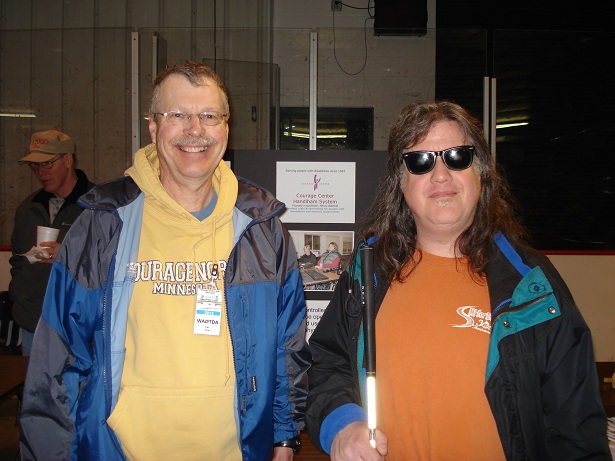
Pat, WA0TDA, and Matt, KA0PQW pose in front of the Handiham table. Photo by Susan Tice.
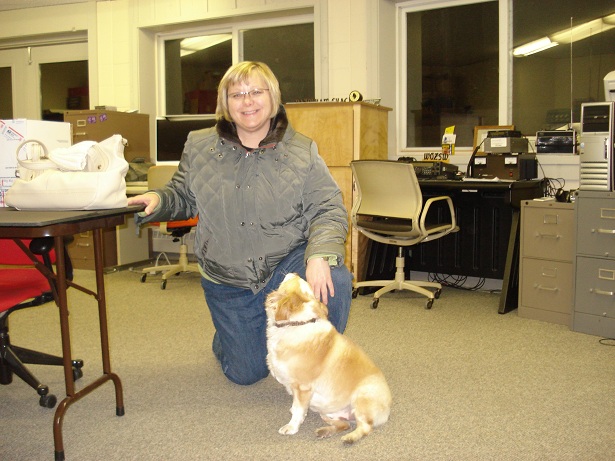
Susan Tice and Jasper get ready for the hamfest by helping to pack the booth equipment at Handiham Headquarters. Asked if it was a tough job, Jasper said, “ruff”. WA0TDA photo.
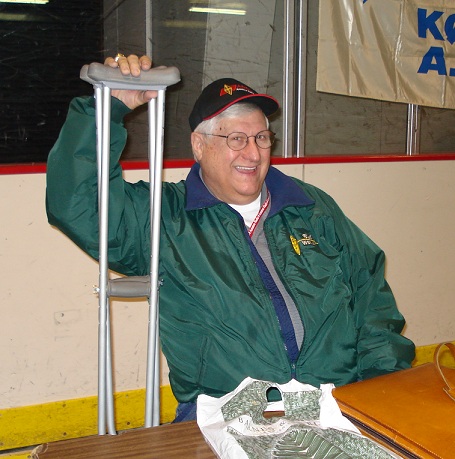
Bob, W0LAW, ARRL Minnesota Traffic Manager, mugs it for the camera at the ARRL booth, right next to the Handiham booth. WA0TDA photo.
Now, to our special feature: Communicating with other hams: It’s all about exchanging information.
Ready to review the basics? Good! Let’s get started.
The basics
Start with callsigns: My callsign is WA0TDA.
Every other station has one, so you will use both of them to initiate a contact:
“W0ZSW, this is WA0TDA”.
Identify!
• Use your callsign.
• Speak clearly & slowly.
• Use phonetics when conditions make hearing difficult.
• Position your microphone correctly.
• Repeat (or ask for a repeat) of the information as necessary.
When you are done talking… (Read more on the Handiham website, or listen to the audio podcast.)














